Villanueva 2026: The Living Memory of Cuban Theater
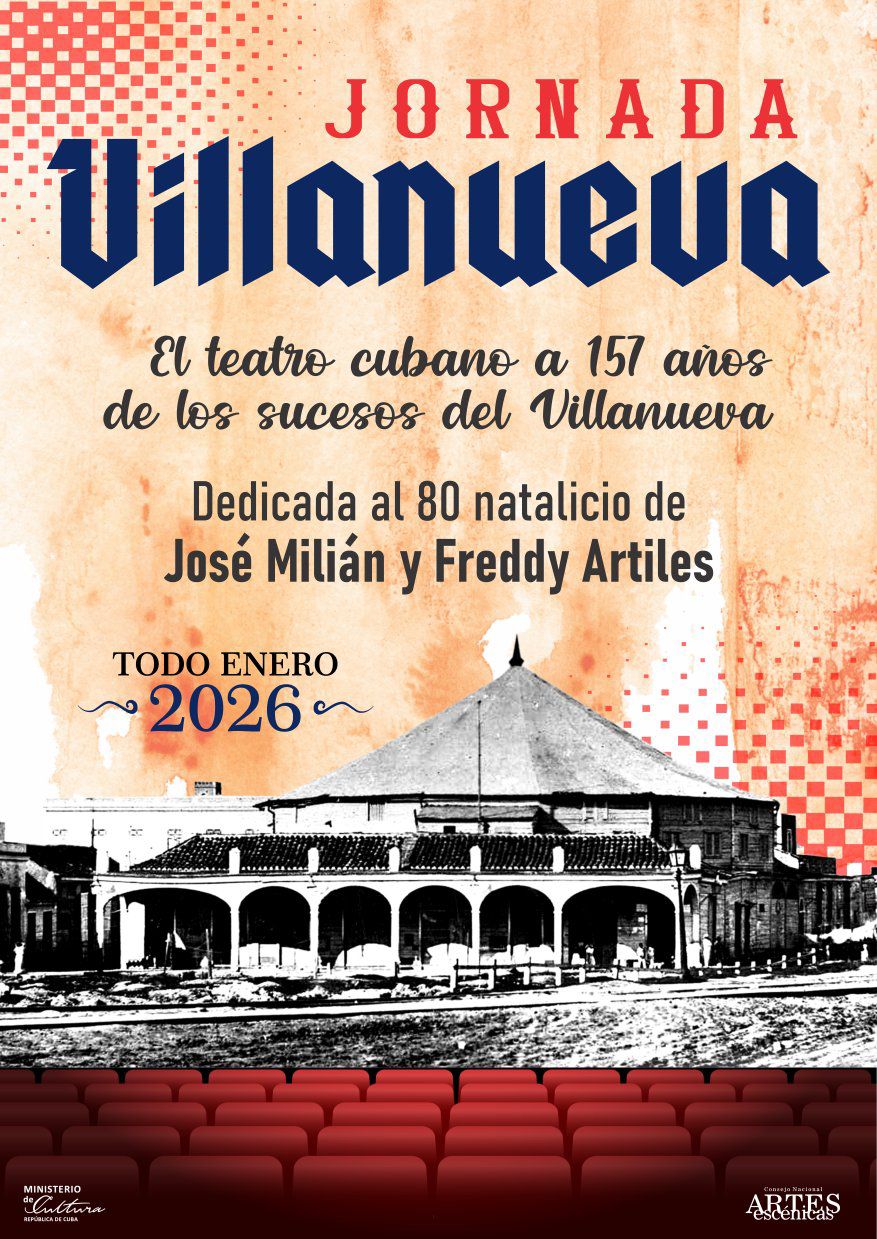
The Villanueva 2026 Festival, which throughout January turned cities and theaters into forums of memory and contemporary creation, has brought down the curtain on a resoundingly successful edition. The event reaffirmed the vitality, diversity, and nationwide reach of theater in the largest archipelago of the Antilles. Under the theme “El teatro cubano a 157 años de los sucesos del Villanueva,” the celebration once again consecrated the stage as a space for collective thought, confirming that Cuban theater remains present, restless, and essential.
Conceived as an exercise in living memory, the festival centered on commemorating the events of January 22, 1869, at Havana’s Villanueva Theater, when an audience chanting pro-independence slogans was brutally repressed by the Spanish colonial authorities. That foundational gesture—when theater became a political act and a declaration of national identity—was the spirit that ran through the entire program.
The 2026 edition took on special significance by being dedicated to the 80th anniversary of the births of two pillars of the national stage: playwright José Milián and critic and researcher Freddy Artiles. Their legacy was the guiding thread of a program structured around three core axes: historical memory, academic dialogue, and scenic diversity.
The Havana program delivered a series of milestones that set the tone for the festival, combining tributes, critical reflection, and the presentation of several major awards.
On January 22, Cuban Theater Day, the country’s highest distinction for the performing arts was awarded to acclaimed actor Fernando Hechavarría, in recognition of an exceptional career. The day before, on January 21, Uneac’s Sala Villena had hosted the award ceremony, organized by the institution’s Criticism and Research Section.
Scheduled tributes to Milián and Artiles were also held. On January 13, a panel at Teatro La Proa examined the extensive legacy of Freddy Artiles, with contributions from colleagues and scholars such as Blanca Felipe Rivero and Rubén Darío Salazar. On January 20, at Sala Tito Junco, audiences attended an emotional staged reading of José Milián’s previously unpublished play La vaca que canta, a unique event that brought the public closer to the playwright’s work.
One particularly moving chapter of the festival was dedicated to Pelusín del Monte, officially proclaimed Cuba’s National Puppet. It was recalled that Freddy Artiles himself had been one of the driving forces behind that designation. The tribute coincided with the declaration of 2026 as the Año Pelusín del Monte by the Cuban Center of the International Puppetry Association (Unima), thus linking homage to the masters with the celebration of a beloved popular symbol.
Another highlight was the concert Canciones viejas siempre nuevas, directed by Rubén Darío Salazar on January 11 at the theater of the National Museum of Fine Arts. Panel discussions on theater training were held at the University of the Arts of Cuba and at Uneac, featuring figures such as Raquel Carrió and Osvaldo Cano. The presentation of publications including the bulletin Prometeo and the book Rito y representación. Registro de la memoria further enriched the theoretical dialogue.
The true scope and most innovative spirit of the festival, however, were evident in its expansion across other provinces, where each territory added its own character and demonstrated that Cuban theater is written in multiple accents.
Ciego de Ávila experienced one of the most symbolic and emotional moments of the entire event. The performance of Náufragos, by the company Caminos Teatro directed by Juan Germán Jones, at the Teatro Principal, became a genuine cultural happening. The return of audiences to this emblematic venue, after years of closure for repairs, charged the evening with special emotion. The response was so strong that, due to high demand, additional performances have already been scheduled for mid-February. The local program also included a talk on Theater Day, children’s performances such as Soñando en colores by Guiñol Polichinela, street theater with Gente de barro, and recognition for actors from various companies for their sustained work.
In Las Tunas, from January 21 to 24, the local Villanueva program paid additional tribute to local actress Adelaida Villavicencio and, on the centenary of his birth, to actor Alfonso Silvestre. The premiere of a new version of Contigo pan y cebolla, by Héctor Quintero, staged by the group Total Teatro, stood out among the highlights. The gathering was further enriched by guest companies from Granma, Villa Clara, and Santiago de Cuba, and included the presentation of the provincial Alborada and Puertas Abiertas awards.
With one of the longest schedules—from January 2 to 29—Matanzas marked several key institutional anniversaries: 25 years of Teatro Icarón, 15 of Teatro El Portazo, 30 of the gallery El Retablo, and 10 of the Museum of Wooden Sculptures of Cuban Playwriting. As part of the celebrations, Teatro Icarón prepared the premiere of Baños Públicos, by Esther Suárez Durán. The province also hosted the second edition of the Laboratory Archive of Scenic Memory, a theoretical space dedicated to analyzing the documentation and preservation of theatrical heritage.
Camagüey, in turn, placed the emphasis on training with the academic premiere of El peso de una isla, performed by third-year students from the Vicentina de la Torre Academy of Arts. Under the direction of professor Leonardo Leyva Fernández, the production gave pride of place to artistic education over professional ensembles.
Granma celebrated several local anniversaries, including the 170th anniversary of the Manzanillo Theater, the 70th birthday of actor Norberto Reyes, and the 35th anniversary of the company Andante. The program featured three premieres by the groups Andante, Ategua, and Tiempos.
The Villanueva 2026 Festival proved to be far more than a historical commemoration. It was a living, wide-reaching celebration that achieved a delicate balance: honoring the memory of its masters, recognizing the work of creators across the country, giving space to new generations, and, above all, reconnecting with an audience eager for quality theater.
From the strong turnout in Ciego de Ávila to the theoretical reflection in Matanzas, the event confirmed that theater in Cuba retains a vibrant restlessness and a constant dialogue with its time and its people. The festival closed not as an ending, but as the raising of a hopeful curtain on the theater year ahead—reaffirming that the stage continues to be an essential space for thought, identity, and collective encounter for the nation.
Translated by Luis E. Amador Dominguez