Jilma Madera: The Sculptor Who Defied Marble and Silence
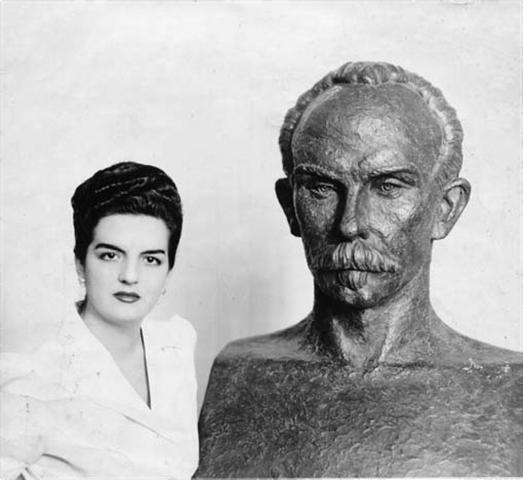
Jilma Madera is not just the name of an artist; it is the signature carved into some of Cuba’s most emblematic stone. Born in 1915 in San Cristóbal, Pinar del Río, she pushed against the conventions of her time to create works that are now inseparable from the country’s landscape and national soul. Her legacy is a perpetual dialogue between monumentality and intimacy, between public recognition and the mysteries time has woven around her life and work.
Her path into art was anything but conventional. Before taking up the chisel, she graduated in Economics in 1936 and studied Education. Her artistic vocation, however, led her in 1942 to the classrooms of the prestigious San Alejandro Academy of Fine Arts. There, under teachers such as Juan José Sicre — creator of the José Martí monument in Plaza de la Revolución — she absorbed the principles of monumental art and mastered the representation of the human figure.
Her style took shape within a neoclassical framework with a marked tendency toward stylization. She never abandoned figuration; instead, she exalted the human form with a personal stamp — a careful balance of volume, space, and light. She liked to say that the sun was a sculptor’s best assistant, for its ability to draw chiaroscuro across the stone.
Madera’s catalogue exceeds 700 works, but three pieces define her stature.
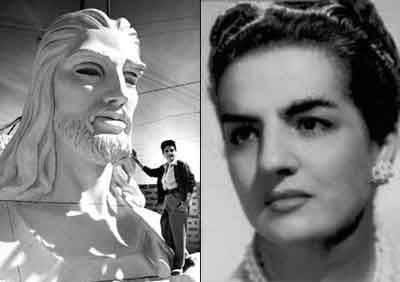
El Cristo de La Habana (1958) broke with convention for its time: it presents a mestizo Christ, with Cuban features, broad shoulders, and a serene yet earthly expression. The sculpture was a commission linked to the wife of President Fulgencio Batista, and its inauguration in December 1958 coincided with the regime’s final days. Madera, who described herself as anticlerical but admired Jesus as a defender of the poor, stated firmly: “I made it so he would be remembered, not worshipped: it is marble.”
Her Busto de José Martí on Pico Turquino (1953) was created to mark the centenary of the National Hero’s birth. Madera sculpted the bust in bronze. Without state support, she financed the casting and the costly transport to Cuba’s highest peak by selling medallions bearing Martí’s likeness. With the help of her friend Celia Sánchez, she managed to install it there in 1953 — an act of pure patriotism and tenacity, for which she received no payment.
Her Parque de los Mártires (1960s) features a sculpture of a couple — a standing man and a kneeling woman clinging to his leg — carved directly in stone. Its meaning remains something of a riddle: some records describe it as a Monument to the Martyrs of July 26, while the intimate arrangement of the figures led local residents to call it Lovers’ Park.
Her public, large-scale career reached a turning point after 1959. Struggling with glaucoma that severely affected her vision, she stopped producing monumental works. She took part in the 1961 Literacy Campaign and, in her later years, devoted herself mainly to translating from English.
In that context, Jilma Madera was a pioneer: she opened a path in a field dominated by men, proving that women’s hands could command stone on a heroic scale.
Her art transcends politics. Whether it is the Christ watching over the bay, the Martí crowning the island, or the silent couple in the park, Madera sculpted symbols of human steadfastness, serenity, and deep emotional connection. Her work speaks of faith, homeland, love, and pain, through a formal language that favors harmony and clarity.
Today, her memory demands recognition equal to the magnitude of her work. To rediscover Jilma Madera — especially through her lesser-known pieces — is to reconcile ourselves with an essential part of our cultural history. It is to remember that greatness is sometimes found both in the colossal works everyone sees and in the quiet enigmas that wait, just around the corner, for an attentive gaze to give them back their voice.
Translated by Luis E. Amador Dominguez