A Decade After His Passing: The Friendship That Bound Dario Fo to Cuba
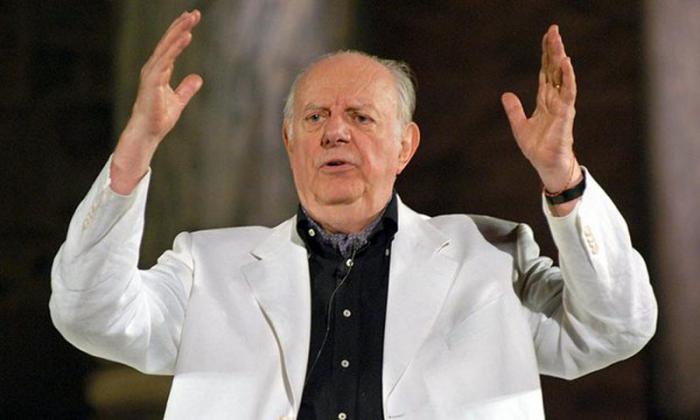
On October 13, 2016, the world of theatre lost one of its most irreverent jesters. Dario Fo died at Milan’s Sacco Hospital at the age of 90, following pulmonary complications that had kept him hospitalized for ten days. His son, Jacopo, paid tribute to him with words that captured a lifetime of creative determination: “My father held on and kept working for eight, nine, even ten hours a day until he had to be hospitalized. Art, passion, and political commitment are things that matter.” For Cuba, however, the news carried a particular poignancy. It was not simply the death of a Nobel laureate; it was the loss of a friend.
Dario Fo’s relationship with Cuba had deep roots and extended across multiple fields. Prometeo, a bulletin published by Cuba’s Center for Documentation of the Performing Arts, explicitly acknowledged those ties in a commemorative edition marking his centenary: “On March 24, the world will mark the centenary of Dario Fo, the jester who won the Nobel Prize in Literature in 1997, maintained close ties with Cuba, and whose works have become part of the repertoire of our theatre practitioners.” Brief and precise, those words encapsulate decades of cultural exchange, mutual admiration, and shared commitment.
The most visible and celebrated chapter in that relationship unfolded in January 1984, during the Havana Theatre Festival. Fo and Franca Rame, his life partner and fellow performer, took part in an edition that brought together ten international theatre companies and prominent figures such as Swedish actress Bibi Andersson. In Havana, Fo presented excerpts from his already legendary Mistero buffo, staging several scenes, including La noche de Caná, Bonifacio VIII, and La resurrección de Lázaro. Critic and journalist Jaime Sarusky interviewed him for the magazine Tablas, and their conversation remains an invaluable record of Fo’s visit to the island.
Fo was never one to mince words. In a 1967 interview with Conjunto, he remarked on the fear and moralism that, in his view, often emerged in countries embarking on revolutionary processes. “There is always fear in countries that are beginning a revolution, and what emerges is moralism rather than morality,” he said. The remark sparked debate and encapsulated his critical, never unconditionally approving, stance—even toward political movements that earned his sympathy. In another interview published in Prometeo, Fo acknowledged that one aspect of his 1984 visit had troubled him: he had been unable to perform in schools, a restriction he regarded as a shortcoming of the festival.
Fo’s influence in Cuba, however, extended far beyond that visit. His plays became a regular part of Cuban theatre practice. Pareja abierta, co-written with Franca Rame in 1983, has been staged on numerous occasions. Teatro Pálpito has performed the play at events such as the International Low-Budget Film Festival in Gibara and at the Terry Theatre in Cienfuegos. Una mujer sola was staged by Teatro Paquelé, while Tengamos el sexo en paz inspired the one-person show Sex-teando con Darío Fo, which actress Yuliet Montes performed in Havana for years. Muerte accidental de un anarquista, perhaps his best-known play, features in the repertoires of Cuban theatre companies and in theatre school curricula.
In 2004, twenty years after Fo’s visit, Ediciones Alarcos published a volume entitled Teatro, bringing together several of his plays in Spanish translations by Carla Matteini, who translated his work into Spanish. Fo’s presence on the Cuban stage was no passing episode; it was a sustained and ongoing current.
The Italian artist’s political commitment to Cuban causes also left a tangible mark. In October 2011, Fo added his signature to an international appeal calling for the return to Cuba of the five Cuban anti-terrorist agents imprisoned in the United States. The statement, circulated by the television program Mesa Redonda and the news website Cubadebate, noted that Fo had joined other Nobel laureates, including Adolfo Pérez Esquivel, Wole Soyinka, and Rigoberta Menchú, in a petition that had already garnered the support of more than 500 prominent figures from around the world. This was no mere formal gesture of support. Fo had consistently expressed solidarity with Cuba in his public statements, and his endorsement of the cause of the Cuban Five was one of many signs of a friendship that went well beyond the arts.
Fo’s relationship with Cuba also had an institutional dimension. Casa de las Américas, a pioneering institution for cultural dialogue across Latin America, counted him among the distinguished figures who had walked its halls. Like other intellectuals, he understood Casa de las Américas as a meeting place and a bastion of cultural resistance. His name thus joins those of countless others who regarded Havana as a point of reference for critical thought and committed artistic creation.
Time has done little to diminish his presence. In March 2026, marking the centenary of his birth, the Dario Fo and Franca Rame Foundation announced a wide-ranging program of worldwide celebrations, including tributes in Italy and other countries where his work had taken root. In Cuba, the Cienfuegos Drama Center chose one of his plays, Un muerto en venta, to mark the company’s 63rd anniversary. Its leaders described the choice as a bridge between the critical tradition of European theatre and the creative vitality of the Cuban stage. The newspaper Granma also published an article celebrating what it called the “consummate jester,” recalling that Fo was a friend of Cuba and its noblest causes and that his plays regularly feature in the repertoires of Cuban theatre companies. The magazine La Jiribilla and other Cuban cultural publications have kept his memory alive through analyses of his dramaturgy and retrospectives on his visits to Cuba.
Ten years after his death, Dario Fo’s legacy takes on a significance that goes beyond easy praise. He was not merely a brilliant playwright, a prodigious actor, or a controversial Nobel laureate. He was an artist who understood theatre as a space for confrontation and dialogue, and who found in Cuba a worthy interlocutor and a loyal friend.
Translated by Luis E. Amador Dominguez
Photo: Granma