Pepe Tallet: The Rumba Poet Who Defended the Spanish Language and Cuba’s Memory
José Zacarías Tallet Duarte was born in Matanzas on October 18, 1893, in a small house at 79 O’Reilly Street, the same house that had once been the residence of José María Heredia, the poet who sang of Niagara Falls. That detail, almost anecdotal, seemed to foreshadow a literary destiny. Tallet lived for 96 years, from the twilight of the nineteenth century to the closing decades of the twentieth, witnessing cultural, political, and social transformations on a scale difficult to summarize. A poet, journalist, teacher, and revolutionary, he gradually became a legend in Cuban national culture. Pablo de la Torriente Brau jokingly dubbed him “the rumba poet” after his celebrated poem La rumba, but Tallet’s legacy extends far beyond that nickname.
Tallet grew up in a provincial, lower-middle-class family. His adolescence and youth unfolded amid the cultural atmosphere of Matanzas and his discovery of literature as a means of intimate expression. He traveled to the United States with his family and began studying business, more out of respect for his elders’ practical expectations than from any genuine vocation. After returning to the island, he held a variety of jobs: cashier, secretary, typist, accountant, clerk, librarian, and translator. This diversity of occupations did not hinder his intellectual development; rather, it reflected an era in which writers and artists had to earn a living on several fronts. Tallet published his first poems in two magazines in 1923 and quickly gained recognition. His name began appearing in anthologies in 1926, and in 1928 he wrote La rumba, the poem that established him as one of the pioneers of Afro-Cuban poetry in Cuba.
His commitment to revolutionary causes was no less significant than his literary vocation. He took part in the Protest of the Thirteen, the Cuban Action Phalanx, the Veterans and Patriots Movement, and the Minorista Group. He was a close friend and brother-in-law of Rubén Martínez Villena, one of the most admired figures among the revolutionary intellectuals of the 1920s. He worked alongside Julio Antonio Mella in founding and organizing the José Martí Popular University and participated in the 1934 workers’ congress, as well as in conspiratorial activities against successive republican governments. He founded the Anti-Imperialist League in 1925 and was an active member of the Minorista Group that rallied around Villena. His poem Proclama became a landmark of Cuban social poetry, containing a line that captures his outlook: “You are right, proletarian, to distrust the one who sings of the torrent but never leaps into it.”
Tallet’s career in journalism began in 1926, and he never abandoned the profession. He served as director, deputy director, and editor of numerous newspapers and magazines. His work during the 1920s and 1930s was particularly intensive: he translated news cables, served on the editorial board of Venezuela Libre, managed América Libre, edited Revista de Avance, headed the magazine section of the newspaper El Mundo, wrote for Baraguá, contributed articles to El País and El Mundo, and served as deputy editor of the newspaper Ahora. His work also appeared in publications such as Social, Chic, and Carteles. By then, he had become a prominent figure in Cuban journalism. His involvement from the founding of the Manuel Márquez Sterling Professional School of Journalism in the early 1940s further confirmed his standing. In 1959, he was appointed the school’s director and taught there for seventeen years.
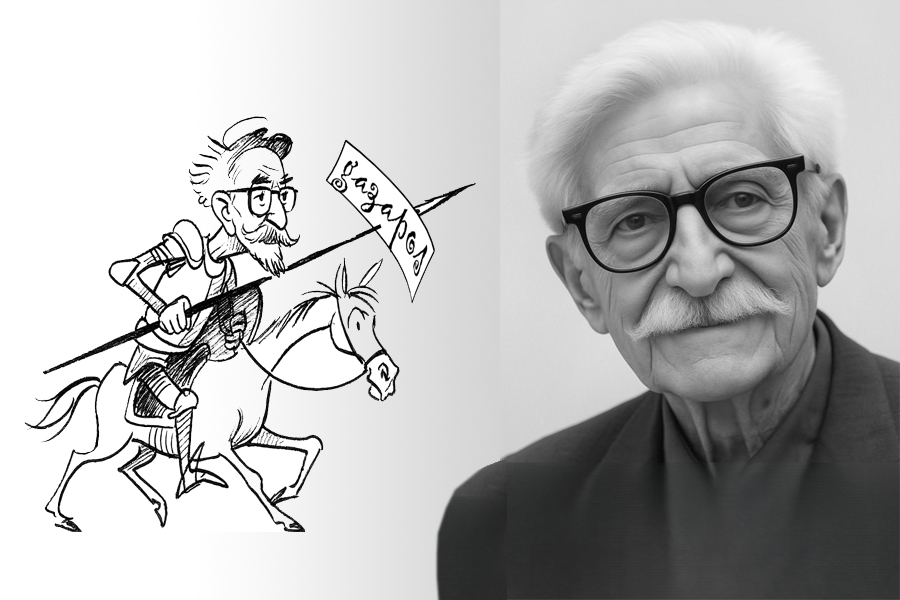
Yet if one aspect of Tallet’s work endeared him to generations of readers, it was his Gazapos column. First in the newspaper El Mundo and later in the weekly magazine Bohemia, he set about correcting language errors with gentle humor and a depth of knowledge that never became pedantic. His book Evitemos gazapos y gazapitos, published by Letras Cubanas in 1985, compiled many of these notes and became an indispensable reference for anyone concerned with the proper use of the Spanish language.
Although modest in volume, Tallet’s poetic output has consistently earned critical recognition for its depth. During his lifetime, he published just one collection of poetry, La semilla estéril, in 1951, bringing together much of the verse he had written over the preceding two decades. The collection includes La rumba, a poem that the celebrated Argentine reciter Berta Sinbermann incorporated into her repertoire and performed throughout the Spanish-speaking world. Critic Max Henríquez Ureña ranked Tallet second chronologically among those who developed Afro-Cuban poetry in its picturesque and folkloric vein. In 1969, Órbita was published by UNEAC, and in 1978 Vivo aún appeared, a collection of fifty poems demonstrating that Tallet’s poetic voice remained vibrant. The following year, Poesía y prosa was published, bringing together his principal works up to that point.
Recognition came late, but it came. In 1984, Tallet received the National Literature Award, only the second such prize to be presented in Cuba, following the award to Nicolás Guillén the previous year. It was not an award based on the volume of his output: Tallet had spent decades maintaining his personal modesty, never regarding himself as the pinnacle of literary achievement. That same year, the University of Havana awarded him an honorary doctorate. He had also received the First Class Félix Varela Order in 1982 and the Julius Fučík Medal, presented by the International Organization of Journalists.
José Zacarías Tallet was more than the poet behind a celebrated book or the journalist who wrote a popular column. He was a man who lived through nearly a century of Cuban history with unwavering curiosity and intellectual integrity. He defended the language with humor, fought injustice through poetry, and left behind a body of work that was anything but sterile. His seed continues to germinate in every reader who discovers his poems, in everyone who consults his collections of language errors, and in every Cuban who recognizes language as an essential part of national identity. As the 133rd anniversary of his birth approaches, Pepe Tallet remains a living touchstone of Cuban national culture.
Translated by Luis E. Amador Dominguez