The José Martí National Library: 125 Years of Memory, Letters, and Nationhood
On October 18, 1901, a group of Cuban intellectuals brought to life an idea that seemed destined to endure. In a small room inside the Castillo de la Real Fuerza, with no books, no shelves, and no librarian, Domingo Figarola Caneda took office as its first director. An encyclopedist, bibliographer, and journalist, he had lost his only son in the struggle for Cuba’s liberation.
That gesture, almost symbolic amid the occupying government’s official indifference, marked the birth of the institution now known as the José Martí National Library of Cuba. Military Order No. 234 authorized its establishment, but it was the determination and cultural commitment of those who championed the project that gave it real meaning. According to researchers, founding the National Library was an anti-annexationist act carried out during the US intervention, an effort to affirm national identity in the face of external pressure.
Figarola Caneda did more than assume the post. He donated the first books from his personal collection, and that initial contribution became the foundation of a heritage that grew through donations, exchanges, and purchases from book collectors. The following year, the Library moved to the Maestranza de Artillería, where its holdings found a more suitable home. In 1909, the Revista de la Biblioteca Nacional was launched, thanks to the donation of a small printing press by Pilar Arazosa de Muller. Over time, the publication would become one of the country’s oldest, second only to Bohemia, and its pages would feature contributions from leading figures in Cuban intellectual life.
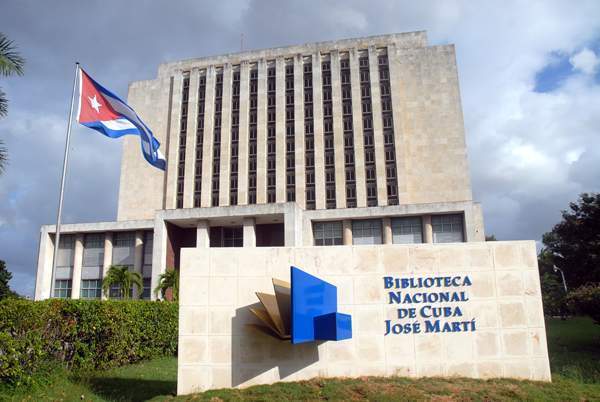
The connection with José Martí did not come immediately. In 1949, at Fernando Ortiz’s initiative, it was agreed that the building to be constructed in the years ahead would bear Martí’s name. Ortiz’s proposal reflected a deep conviction: the National Library should be named after the man who had made culture and freedom inseparable causes. The monumental 17-story building was inaugurated on February 21, 1958, facing Plaza de la Revolución. On that occasion, Fernando Ortiz delivered a statement that captures the institution’s spirit: “Let us hope today that this Martí Library building will be a new Castillo de la Fuerza, from which the Cuban nation can defend its civilization, its Republic, and its freedom against enemies of every kind.” The building’s architecture, featuring stained-glass windows by French master glassmaker Auguste Labouret and a dome twelve meters in diameter, makes the Library one of Cuba’s architectural gems of the twentieth century.
Its history is inextricably linked to the development of Cuban culture throughout the twentieth century. From its founding to the present day, no major period or figure in Cuban intellectual life has remained untouched by its history. Figures such as Emilio Roig de Leuchsenring, the leading advocate of the movement that secured the construction of the new building, and Fernando Ortiz himself illustrate the sense of responsibility with which Cuban intellectuals embraced the institution’s development as their own undertaking.
Its halls have welcomed distinguished directors, including María Teresa Freyre de Andrade, Cintio Vitier, Renée Méndez Capote, Juan Pérez de la Riva, Julio Le Riverend, Eliades Acosta, and Eduardo Torres-Cuevas, among others. Each left a mark on an institution that, in the words of critic and essayist Omar Valiño Cedré, its current director, “(…) steadfastly upholds the highest values of what this country has built over the centuries.”
The Library’s holdings are exceptional in both scale and scope. More than four million items—including books, magazines, newspapers, documents, maps, and images—make up its collections, with materials dating from the fifteenth century to the present. Its holdings include Cuban and foreign prints; documents and books associated with Domingo del Monte, Zenea, and Julián del Casal; rare and valuable facsimiles; clandestine publications; music; materials on ethnology and folklore; sound recordings; manuscripts; and maps. The Cuban Collection encompasses everything published in the Caribbean nation, or about the country and its people, anywhere in the world, in any period or language, as well as works by Cuban authors published abroad. Its bibliography on José Martí is considered the most comprehensive of its kind, and in 2005 this collection received UNESCO’s Memory of the World recognition. In 2018, the Library acquired the valuable collection of manuscripts, letters, and photographs belonging to poet Dulce María Loynaz, which it now safeguards and preserves.
The Library’s reading rooms and specialized spaces reflect this wealth. The Antonio Bachiller y Morales Cuban Collection Room, the Wifredo Lam Art Room, the Martí Collection Room, the Ethnology and Folklore Room, the Photographic Archive, the Map Room, and the León-Murguecia Music Room are among the facilities that give researchers and readers access to a body of knowledge that helps define Cuban identity. The building was declared a National Monument on June 30, 2021. Its excellent functional and bioclimatic design incorporates reading rooms intended to benefit from natural light and ventilation. The designation, granted by the National Monuments Commission of the National Council for Cultural Heritage, recognized the historical, artistic, environmental, and social value of a building that forms part of the country’s political and administrative center and stands as one of the most significant public spaces for Cubans.
The National Library’s history also encompasses periods of profound transformation. Following the triumph of the Revolution in 1959, the institution assumed a leading role in the nationwide campaign to promote reading. María Teresa Freyre de Andrade, its director at the time, developed policies to address the growing demand for information in a country where thousands of professionals had emigrated. Researcher Tomás Fernández Robaina, who witnessed that period, recalled the creation of science and technology reading rooms and specialized centers to advise nationalized enterprises. In 1985, the Library became the coordinating institution for the National Public Library System. Its work proved crucial in keeping the country’s more than 300 libraries open during the Special Period. In 2001, it received the Félix Varela Order.
As another anniversary of its founding is marked, the José Martí National Library endures as a symbol of Cuba’s determination to preserve its collective memory and as a place where culture is explored, reflected upon, and shared. Ultimately, it is a castle of knowledge that safeguards the memory of a nation and projects it into the future.
Translated by Luis E. Amador Dominguez
Photo: Ecured