Adigio Benítez: The Craft of a Committed Artist
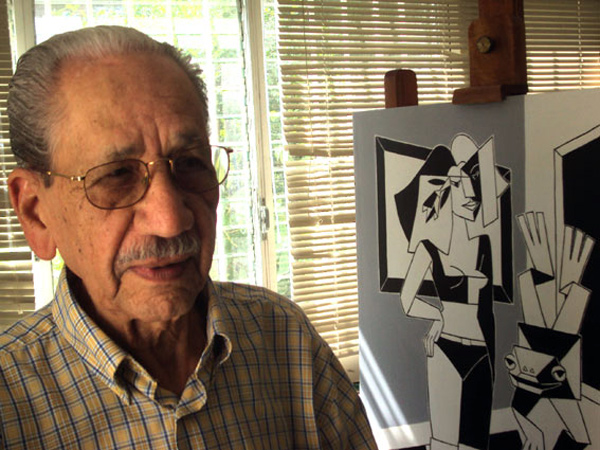
Adigio Benítez Jimeno (1924–2013) was a defining figure of twentieth-century Cuban art, known for his authenticity. A consummate creator, Benítez wielded brush, pencil, and poetic word in service of a profound social vocation, all while rigorously exploring the artistic languages of his time. More than a painter, Benítez was a visual narrator of his era, a master who shaped generations, and an intellectual whose commitment to Cuban culture earned him the nation’s highest honors.
Benítez was born in Santiago de Cuba on January 26, 1924. His artistic journey began in earnest when, as a young man, he moved to Havana to enroll in the prestigious San Alejandro Academy of Fine Arts.
However, economic hardship—a constant in his youth—forced him to abandon his initial studies. Undeterred, he worked as a laborer in a ceramics workshop in Santiago de Las Vegas and, driven by determination, secured his first opportunity at a local newspaper. This early introduction to graphic journalism would forever shape his path.
By the mid-1940s, Benítez’s agile and critical line began appearing in various progressive Cuban publications. His political activism led to collaborations with Mella, the magazine of young communists, and in 1949, he began contributing to Hoy, the newspaper of the Popular Socialist Party.
This work was not without risk. During Fulgencio Batista’s dictatorship, Benítez was targeted by repressive authorities and even imprisoned. When Hoy was shut down in 1953, he continued the clandestine struggle, publishing protest drawings in Carta Semanal under pseudonyms like Laura, Abejota, and A. del Campo.
Benítez’s plastic art reflects both his personal evolution and Cuba’s historical context. His earliest oil paintings date from 1953, depicting with raw empathy the dire conditions faced by workers and peasants.
During the 1950s, as Cuban painting shifted toward abstraction, Benítez stood apart, steadfast in his pursuit of a socially conscious realism. Works like Maternidad (1954), Trabajadores (1957), and his remarkable poster portrait of union leader Jesús Menéndez (1958) are emblematic of this period. The latter, in poster format, earned him the Cuban Workers’ Press Prize in 1948.
After the revolution, Benítez’s artistic vision evolved. He absorbed social changes and experimented with new forms. Series such as Los soldadores (1962–1963) reveal an approach to abstraction, though drawing always remained at the core of his work.
In 1969, his exhibition “Papiros en La Habana” marked a significant moment. Influenced by a belated understanding of Cubism, he explored the possibilities of origami, blending them with appropriations from universal art. His style was generally defined by rigorous formal mastery and a constant search for expressive depth.
Benítez also shared his experience through teaching. With the Revolution’s triumph, he balanced his work at Hoy with a teaching position at the newly founded National Art School. He was a founding professor at both the National School of Visual Arts and the Higher Institute of Art (ISA). His dedication was so notable that, in 1987, ISA awarded him the special title of Professor of Merit. In 2003, the Cuban state recognized his contributions with the National Award for Artistic Teaching.
Benítez’s influence transcended Cuba’s borders. From 1979 to 1983, he presided over the International Association of Visual Artists, later becoming its Honorary President. He participated in more than a hundred collective exhibitions in Cuba and abroad, including biennials in Mexico and São Paulo.
He was also awarded the Félix Varela Order, First Degree (1994), the National Visual Arts Award (2002), and the National Award for Artistic Teaching (2003), in recognition of his exemplary pedagogical work.
Benítez died in Havana on May 9, 2013, at the age of 89. His works are held in the Cuban Art Collection of the National Museum of Fine Arts, Casa de las Américas, and other institutions and private collections in Cuba and overseas.
He was the very image of an accomplished and committed artist—a man who, through drawing, painting, teaching, and even poetry (he published four books of verse), engaged in dialogue with his times without betraying his convictions. As a leading figure in twentieth-century Cuban visual arts, Benítez’s career serves as a reminder that in his hands, art was always an act of faith in life and in the dignity of his people.
Translated by Luis E. Amador Dominguez
Photo: Cubahora