José María Vitier: Cuba’s Intimate Score
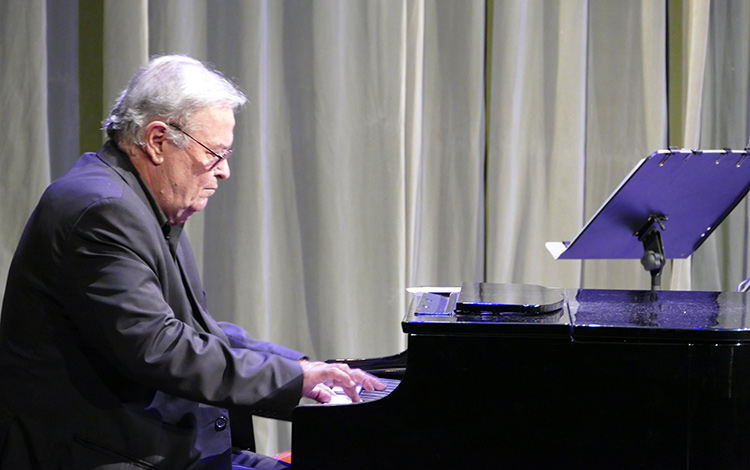
Each January 7, Cuban culture marks the birth of one of its most versatile and beloved musical voices: José María Vitier García-Marruz. Born in Havana in 1954, his body of work—from intimate piano pieces to monumental film scores—has become a sustained and eloquent dialogue with Cuban identity.
The son of foundational poets Cintio Vitier and Fina García Marruz, and the brother of award-winning composer and guitarist Sergio Vitier, José María grew up in an environment where the spoken word and the musical note were inseparable. This family legacy was not a burden, but fertile ground from which he projected his own voice—one that would engage diverse audiences across multiple genres and formats.
His early piano studies, begun in 1962, took him through the classrooms of the Amadeo Roldán Conservatory, where he studied under figures such as Margot Rojas and César López. His professional career took a decisive turn in 1977, when he joined Grupo Síntesis as a pianist and composer—a formative experience that immersed him in fusion music and symphonic rock.
It was in 1983, however, with the founding and direction of his own instrumental ensemble, that he began to consolidate a distinctive musical language. As critics have noted, his music emerges from a natural fusion of European classical tradition, jazz, trova, and Cuban popular rhythms, all infused with an unmistakable sense of cubanidad. This versatility has allowed him to move fluidly between solo piano, chamber ensembles, and large-scale productions for film and television.
Perhaps one of Vitier’s most celebrated roles is his prolific work as a film composer. His relationship with the Cuban Institute of Cinematographic Art and Industry dates back to 1975 and has spanned nearly five decades.
His ability to accompany visual narratives with emotional depth is evident in scores for some of the most emblematic films in Cuban cinema. Notable among them are his music for Fresa y Chocolate (1993), achieving a perfect symbiosis with the story by reinterpreting musical icons of Cuban sensibility; Explosion in a Cathedral (1992), featuring a monumental score for the screen adaptation of Alejo Carpentier’s novel; and A Very Old Man with Enormous Wings (1988), for which he received the prestigious Osella Award at the Venice International Film Festival.
Since 1986, his theme Desde la aldea has served as the signature music of the Havana International Festival of New Latin American Cinema, resonating year after year as an anthem for the region’s seventh art.
José María Vitier’s career has been recognized with the highest honors. In 2021, he received Cuba’s National Music Prize, a distinction that, according to the jury, acknowledged him as an outstanding pianist and composer—a remarkably complete musician whose work resonates with both specialists and the general public. Earlier accolades include the Alejo Carpentier Medal and the Félix Varela Order (2004).
His discography, comprising more than forty recordings, includes essential works such as Misa Cubana a la Virgen de la Caridad del Cobre and the oratorio Salmo de las Américas, the latter nominated for a Latin Grammy Award in 2000. More recently, in 2025, he was honored in China with the 1573 International Composition Award, evidence that his artistic quest and curiosity about dialogue with other traditions—including millennia-old Chinese music—remain fully alive.
Beyond awards, the essence of Vitier as a creator is revealed in his reflections on artistic practice. In a recent interview, he spoke about the creative act: “Creation is an individual and solitary process in which one seeks to express personal emotions… yet one is also part of the audience. One is the ‘first listener.’” This intimate bond between the personal and the universal is the defining hallmark of his music.
As we mark another anniversary of his birth, celebrating José María Vitier is celebrating an artist whose work forms a sonic map of Cuban sensibility. From the most introspective piano piece to the symphonic score, his music endures—because, as he himself believes, “the most moving thing about art is that it never ceases. No adversity can stop it.” His legacy, in constant dialogue between tradition and modernity, continues to write, note by note, the soundtrack of a nation.
Translated by Luis E. Amador Dominguez