Juan Almeida Bosque: The Heart of Revolution and Song
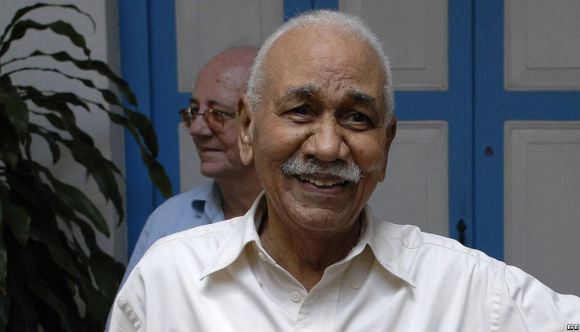
Juan Almeida Bosque was born in Havana on February 17, 1927, into a large, working-class family. Necessity forced him to leave school at eleven and take up work as a bricklayer — a trade that, almost prophetically, put him on the path to his destiny. While doing construction work at the University of Havana, he met a young lawyer named Fidel Castro.
The military coup led by Fulgencio Batista in March 1952 was the turning point. Guided by a strong sense of justice, Almeida immediately joined the nascent struggle against the dictatorship. His commitment led him to one of the foundational actions of the Cuban Revolution: the attack on the Moncada Barracks on July 26, 1953. The military failure had direct consequences: he was captured, tried, and sentenced to ten years in the Presidio Modelo prison on the Isle of Pines, where he shared a cell with Fidel and Raúl Castro.
Released in 1955 under an amnesty, he went into exile in Mexico. There, as part of the small group of 82 rebel fighters of the Granma expedition, he boarded the yacht Granma bound for Cuba in 1956. The landing led to the disaster at Alegría de Pío, where Batista’s troops decimated the rebels. In the chaos, when surrender seemed the only option, Almeida’s voice rang out with a phrase that would pass into history: “Aquí no se rinde nadie” — nobody surrenders here.
As one of just twelve survivors, he made his way up to the Sierra Maestra. His courage and loyalty, tested in battles such as El Uvero — where a bullet struck a metal spoon he carried on his chest and saved his life — earned him promotion to comandante of the Rebel Army on February 27, 1958. Fidel Castro then entrusted him with creating and leading the Third Eastern Front “Dr. Mario Muñoz Monroy,” a crucial responsibility in the war’s final strategy.
With the triumph of the Revolution in January 1959, Almeida’s life shifted from guerrilla warfare to institutional nation-building. He went on to hold some of the highest positions in the new state. He served as Chief of Staff of the Rebel Army; became a founding member of the Political Bureau of the Central Committee of the Communist Party of Cuba (from 1965); Vice President of the Council of State (from 1976); and President of the Association of Combatants of the Cuban Revolution.
His role was decisive at critical moments, such as the Bay of Pigs invasion in 1961, when he served as military commander in the central region of the island and later as a member of the revolutionary tribunal that tried the invaders. In recognition of his exceptional service, the Cuban state awarded him the honorary title Hero of the Republic of Cuba and the Máximo Gómez Order, First Class, in 1998.
But to reduce Juan Almeida to his official résumé would be to ignore half of who he was. He possessed a remarkable human and artistic sensitivity that allowed him to build a cultural legacy alongside his political career. In a feat of creative output, he composed more than 300 songs and wrote around a dozen testimonial books.
His music — spanning boleros, sones, guarachas, and ballads — was born from the people and for the people. Songs such as “La Lupe,” “Dame un traguito,” and “A Santiago” became popular classics, performed by renowned artists including Pacho Alonso, Beatriz Márquez, and Farah María. In 1986, the show La Lupe en Concierto toured Cuba in honor of his three decades as a composer.
As a writer, his pen became a first-hand historical record. His trilogy ¡Atención, recuento! — comprising Presidio, Exilio, and Desembarco — recounts his experiences from Moncada to the first battles in the Sierra Maestra. For his account Contra el agua y el viento, about Hurricane Flora in 1963, he received the Casa de las Américas Prize in 1985.
Juan Almeida Bosque embodied a rare union of action and creation, of the firm hand of command and the delicate sensibility of the artist. His life reminds us that the Revolution was not forged by rifles alone, but also by verses and melodies; that strength of character does not exclude tenderness of heart. In every note of “La Lupe” and every page of his memoirs, the comandante repeats to us, with a calm, enduring voice, that in the effort to leave the world a better place, nobody gives up here.
Translated by Luis E. Amador Dominguez