Justo Vega: The Knight of the Décima and the Voice of the Countryside
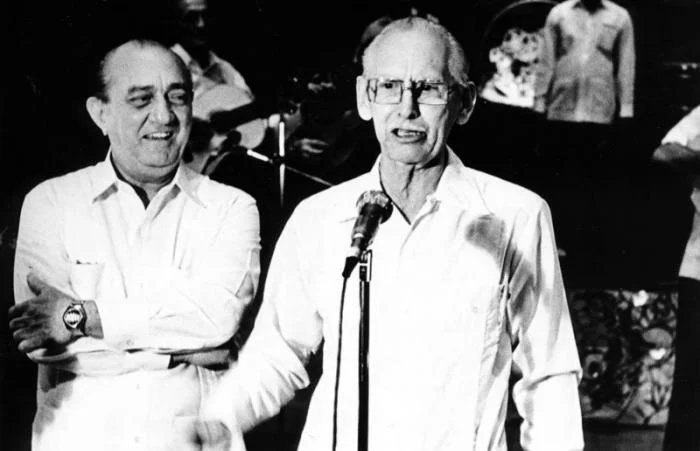
The figure of Justo Vega, always impeccable in his guayabera, stands as a cornerstone of Cuba’s cultural history. His life—a journey from manual labor in the countryside to the most prestigious stages—is marked by his dedication to a unique poetic and musical tradition: Cuban country music and the décima guajira. On the 30th anniversary of his death, on January 13, 1993, in Havana, his legacy remains a living emblem of national identity.
Justo Pastor Vega Enríquez was born on August 9, 1909, in San Antonio de Cabezas, Matanzas, a town with a rich poetic tradition. His childhood and youth were shaped by hard work, forging a character that would later be reflected in his art. Before discovering his calling in improvised poetry, he worked in various trades, including construction laborer, agricultural worker, and café attendant.
His turning point came spontaneously. It is said that one day, he heard the improvisational poets José Guerrero and Eloy Romero engaging in a poetic dialogue. The encounter left him astounded. By the next day, he had reportedly begun to improvise, revealing a natural gift he would refine into mastery over time.
Vega’s rise as an artist coincided with the emergence of Cuban radio. In 1934, he founded the Cuarteto Trovadores Cubanos with his brother Bernardo, Pedro Guerra, and Alejandro Aguilar. The group not only performed concerts but also showcased Vega’s entrepreneurial vision: to promote themselves, he rented an hour of airtime on CMQ radio and personally sought advertisers to cover the costs. The endeavor was a resounding success, propelling his career and opening the door for him to direct advertising for the Partagás Cigar Factory, where he worked for fourteen years. In this role, he devised memorable campaigns such as the “Casita Partagás,” a decorated vehicle that toured towns, and the program La Hora Partagás on COCO radio, which reached unprecedented audiences.
His command of octosyllabic verse and the espinela form placed him among the greats of the genre, alongside figures such as Jesús Orta Ruiz, Chanito Isidrón, and Angelito Valiente. Yet his most enduring contribution arose from a fruitful artistic partnership.
In the late 1940s and throughout the 1950s, Vega helped organize the Festivales de la Décima in the Jardines de la Tropical, regarded by many as the Golden Age of Cuban punto. At these festivals, improvisers competed in color-coded groups (Red, Lilac, Blue, Tricolor), drawing crowds who came to celebrate poetic virtuosity. This period of cultural effervescence laid the foundation for Vega’s rise from a radio personality to a mass phenomenon.
Justo Vega found his perfect counterpart in Adolfo Alfonso. Together, they formed one of the most celebrated duos in Cuban popular culture. Their chemistry was such that audiences divided themselves into “justistas” and “adolfistas” during performances, only to reconcile at the end, aware that the rivalry existed solely on stage.
This partnership reached its peak on national television. With the launch of the program Palmas y Cañas in 1962, Vega and Alfonso became Sunday visitors in countless Cuban homes. Through the small screen, they brought rural tradition into the heart of the city, blending serious, philosophical décimas with intelligent, finely tuned humor far removed from vulgarity. Although Vega once confessed a personal preference for descriptive and romantic décimas, he acknowledged that the audience expected jocular controversy as the main attraction.
After the triumph of the Revolution in 1959, Vega wove his convictions into his work. On his radio program Patria Guajira, he praised the achievements of peasants and workers and used his verse as a tool of political advocacy. In 1960, he even organized a voluntary labor battalion for the sugarcane harvest, a gesture that underscored his ongoing commitment. By 1968, his work was recognized as essential by the Cuban Institute of Radio and Television and the National Council of Culture. From there, he continued to promote rural music within and beyond Cuba, touring several Latin American countries with Adolfo Alfonso.
On January 13, 1993, at the age of 83, he died in Havana, leaving a profound void in Cuba’s cultural landscape. His legacy endures through numerous honors. Institutions bear his name, including a park near his home and the Municipal House of Culture of Arroyo Naranjo in Havana. The National Repentismo Competition also commemorates him, encouraging new generations to cultivate the art he championed. Among the distinctions he received are the Distinction for National Culture and the Replica of Máximo Gómez’s Machete.
Three decades after his passing, Justo Vega, the Knight of the Décima, remains an indispensable figure. His life is the story of a man who transformed rural experience and labor into pure poetry, elevating a popular tradition to the level of high art. His image, always serious and elegant, endures as a symbol of authenticity and decorum, and his work continues to bridge the countryside and the city, linking the past and present of the Cuban nation. As his companion Adolfo Alfonso aptly said, Vega was always “a sun for culture and a gem for art.”
Translated by Luis E. Amador Dominguez
Photo: En Vivo