Manuel Mendive: The Sorcerer of Cuban Visual Art
An artist does not simply search; he finds. The work of Manuel Mendive Hoyos unveils the soul of Cuba in every African-rooted stroke, making visible the invisible depths of our culture. From the streets of Luyanó in Havana to the walls of the Vatican, his creations have built a bridge between the magical-religious world of Afro-Cuban culture and the contemporary expressions of global art. Born in 1944 into a family profoundly linked to Santería, Mendive has become the leading exponent of Afro-Cuban influences in the visual arts—a creator whose spirituality imbues each piece, from painting to performance.
Mendive’s works not only grace museums from Cuba to Norway and Russia, but also engage public spaces through performances that transform bodies into living canvases and summon modern rituals of cultural identity.
He uncovered his earliest visual symbols in the Santería-enriched environment of his family, an influence that would indelibly shape his path. His training was rigorous and twofold: one rooted in Yoruba oral and ritual tradition, the other in Cuba’s most prestigious academic institutions. He graduated with honors in painting and sculpture from the San Alejandro Academy of Fine Arts (1963) and furthered his studies at the Department of Ethnology and Folklore at the Cuban Academy of Sciences, blending technical mastery with deep cultural research from the outset.
His oeuvre forms a comprehensive visual system where gods, humans, animals, and natural elements coexist in a harmonious mythological narrative. Yoruba spirituality, Afro-Cuban identity, and nature as a sacred stage are recurring themes. Ritual objects, natural elements, and biomorphic figures—straddling the forms of humans and animals, sometimes with wings or multiple limbs—symbolize both the Catholic Trinity and the Santería connection of body, spirit, and nature.
Critics agree that Mendive marks a historical turning point in how Cuban art engages its African roots. Before him, Afro-Cuban references in art often tended toward folklorism or ethnographic illustration. Mendive internalized the Yoruba worldview to forge an organic, contemporary visual language.
Throughout his life, he has inspired younger generations of artists to explore Afro-Cuban spirituality and identity from a modern perspective, using a clear and distinctive artistic vocabulary. His receiving the National Prize for Visual Arts in 2001 was official recognition of the centrality of Afro-Cuban tradition in national culture.
Poet and essayist Nancy Morejón highlights how Mendive visually poeticizes traditions often marginalized in dominant cultural discourse. Prominent art critic Gerardo Mosquera notes that in Mendive, African roots naturally integrate into a new entity: the Cuban nation. Carol Damian, director of the Frost Art Museum, observes, «Manuel Mendive unites the human body with the land that gave it birth… It is a totalizing concept of art, where the pictorial merges with body and soul.»
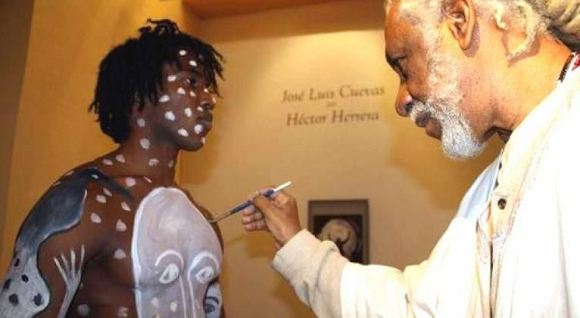
Now in his eighties, Mendive maintains a remarkable creative vitality and continues expanding the boundaries of his own artistic universe. In 2024, he presented his first major retrospective in Cuba, «Pan con guayaba, una vida feliz,» which gathered almost a hundred works at the National Museum of Fine Arts, demonstrating his enduring power to innovate. He also staged performances painting directly on dancers’ bodies, creating living artworks that fuse visual art, dance, and music in contemporary rituals.
Mendive’s legacy ensures his place in the canon of Cuban and Caribbean art for fundamental reasons. His work visually resolves the complex equation of Cuban identity, integrating African, Spanish, and Creole heritage into a distinctive and coherent visual language. In a globalized art world, Mendive exemplifies the value of delving into the local to achieve the universal, without concessions to external expectations. His practice encompasses painting, sculpture, performance, music, and dance, anticipating the interdisciplinary approaches that define twenty-first-century contemporary art.
Manuel Mendive Hoyos has shown that art can be both root and branch: deeply anchored in specific traditions and open to contemporary creative breezes. His work does more than represent Afro-Cuban culture—it makes it tangible in its deepest spiritual dimension. In a world where cultural identities are constantly challenged by globalization, Mendive’s vision provides a powerful antidote: the certainty that honestly looking inward is the surest path to authentic connection with others. His legacy, already inscribed in golden letters in the history of Cuban art, continues to grow and transform, like the sacred trees he loves to paint—roots sunk deep in African soil, branches caressing the Caribbean sky.
Translated by Luis E. Amador Dominguez
Photo: Génesis Galerías de Arte