The Poet of the Nation: The Word that Forged Cuba
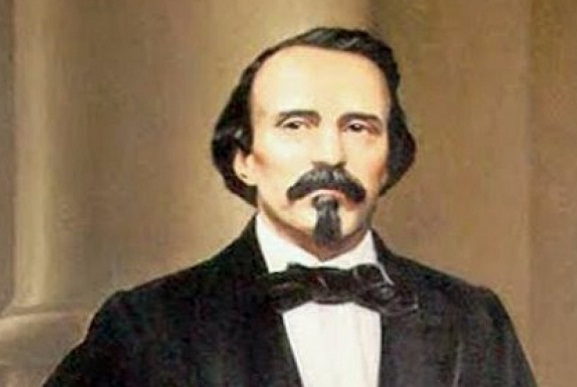
From the very beginning, the life of Carlos Manuel de Céspedes was shaped by learning and letters. Born in 1819 into a wealthy family in Bayamo, he received a refined education. He studied Latin grammar and philosophy in convents in his hometown and later moved to Havana, where he graduated with a Bachelor’s degree in Civil Law in 1838. His thirst for knowledge took him to Spain, where he earned a doctorate in Law and, more significantly, traveled across Europe, the Ottoman Empire, and part of Russia. He was fluent in English, French, Italian, Latin, and Greek. His training went hand in hand with an immersion in the liberal and revolutionary ideas of the nineteenth century.
His poetic output, often written in the intervals of a turbulent life and even from prison, reveals the many layers of his personality. In poems such as Mi deseo (1852), we encounter an intimate, almost bucolic Céspedes who longs for “un techo pobre, escondido” — “a humble, hidden roof” — where family and peace would be his sole horizon. It is the voice of a Romantic.
Yet that same pen could become caustic and militant. In Los traidores (1868), written in the midst of war, he lashes out at those who choose submission: “No es posible, ¡por Dios!, que sean cubanos / los que arrastrando servidumbre impía, / van al baile, a la valla y a la orgía, / insultando el dolor de sus hermanos.” Here, the poet merges with the political leader; lyricism turns into a battle cry. Other poems, such as Al Cauto, showcase his formal mastery and deep metaphysical reflection, as he compares the course of the river to the life of humankind.
His work was not limited to original creation. He cultivated translation with rigor in works such as Virgil’s Aeneid and fragments of John Milton, a fact that reveals his profound respect for universal culture. Even his musical talent left an enduring mark: in 1848, he composed the music for the first Cuban romantic song, La Bayamesa. Its melody would later be adapted by Pedro “Perucho” Figueredo to create the tune of the Cuban National Anthem.
The cultural life of Manzanillo, where Céspedes lived for years, found in him an indefatigable driving force. He was not only a lawyer and landowner, but also a pillar of the local Philharmonic Society. He reformed its statutes to promote a library and a declamation section, and took on the role of stage director. In September 1856, at the opening of the Teatro Manzanillo, Céspedes played the lead role in the comedy El arte de hacer fortuna. Chroniclers of the time praised his skill and distinctive talents on stage. According to oral tradition in Manzanillo, he even staged plays of his own authorship, such as the comedy Las dos Dianas, although these texts have been lost. For him, theater was more than entertainment; it was a space for civic encounter and a means of elevating the community’s spirit.
If his poetry reveals the idealist and his theatrical work the public man, the discovery of his Lost Diary allows us to peer into the abyss of his final loneliness. Written between July 1873 and February 1874, after he was removed from the presidency and confined to a remote encampment in San Lorenzo, these pages constitute a heartrending document.
In them, a dejected Céspedes, fully aware of his approaching fate, reflects on the ingratitude of some of his comrades, records his premonitory dreams, and expresses his love for his distant family. The diary’s prose is direct and unadorned—the voice of a man who knows he is writing for posterity. Historian Eusebio Leal Spengler, who brought this diary to light, underscores how Céspedes accepts with dignity the usefulness of his sacrifice: “El verdadero valor no está en inclinar la cerviz a lo inevitable, está en asumir su utilidad a una causa justa” — “True courage lies not in bowing one’s head to the inevitable, but in embracing its usefulness for a just cause.” In his final entry, dated February 27, 1874, just hours before he fell in combat against a Spanish detachment, that conviction turned into action: he chose death over capture.
He was not a professional man of letters, yet his writing, in all its forms, was integral to his political action. As researcher Dr. Rafael Acosta de Arriba notes, to study his thought is to witness the founding of the Cuban nation. In his manifestos, letters, poems, and diary, he laid out the principles of an abolitionist republic grounded in social justice—concepts that José Martí would later develop and articulate.
Céspedes—the poet, the playwright, the translator, the diarist—endures. Not only as the man who granted freedom to his enslaved people, but also as the one who, drawing on the depth of his learning and the sensitivity of his pen, imagined and wrote the nation long before he could help found it on the battlefield. His true Grito de Yara was first forged in the silence of the blank page.
Translated by Luis E. Amador Dominguez
Photo: Radio Rebelde