Motivos de son at 95: The Enduring Mark of an Unforgettable Milestone
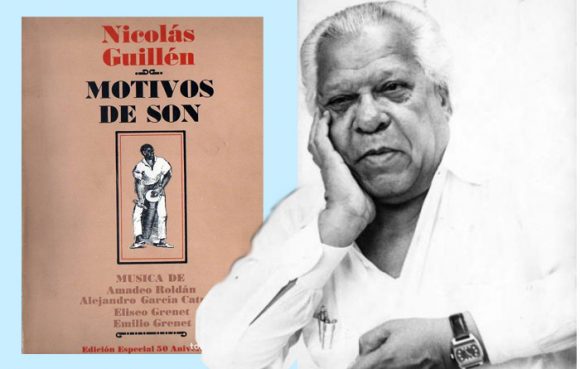
April 20, 1930, stands as a watershed moment in Cuban literature. On that day, a young journalist and poet from Camagüey, Nicolás Guillén, published eight poems in the “Ideales de una raza” section of the influential Diario de la Marina. Under the collective title Motivos de son, the poems — “Negro bembón,” “Mi chiquita,” “Búcate plata,” “Sigue,” “Ayé me dijeron negro,” “Tú no sabe inglés,” “Si tú supieras,” and “Mulata” — appeared in print. The publication did not go unnoticed. Contemporary accounts describe it as causing a genuine stir in the island’s literary circles. No one had heard a voice quite like this in Cuban poetry.
The significance of Motivos de son lies above all in its bold formal and thematic choices. Guillén not only incorporated Havana’s popular speech — with its phonetic shifts and distinctive syntax — but also used as his structural backbone one of Cuba’s oldest and most authentic musical forms: the son. Years later, the poet explained his intention: “I have tried to incorporate into Cuban literature… what might be called the poem‑son.” This choice amounted to a profound act of cultural reclamation. In the early decades of the Republic, as critic Katia Viera notes, “Blackness provoked explicit fear, while the intellectual, social, and political project was to modernize the nation on the foundations of white European civilization.” Against that exclusionary vision, Guillén elevated the rhythm of the neighborhood, the beat of the bongó, and the slang of the solar to the level of aesthetic principle.
Cuban literary critics of the 1930s reacted quickly. Intellectuals such as Raúl Roa, Juan Marinello, and José Antonio Portuondo immediately recognized the poet’s deep connection to the son and his ability to reflect the racial and social dilemmas of Cuban life. Yet it was anthropologist Fernando Ortiz who offered one of the most incisive readings. Ortiz did not classify this poetry as exclusively Black, but rather as mulatto — the product of an inseparable embrace between Africa and Castile. For Ortiz, Guillén’s verses anticipated his later theories on transculturation. Far from being superficial exoticism, Motivos de son revealed the mestizo essence of the Cuban spirit, a synthesis in which African heritage ceased to be a stigma and instead became a pillar of national identity.
Beyond its intrinsic value, the collection proved decisive for Guillén’s later work. Critic Roberto Manzano has observed that once Guillén embraced the Black universe — which, in his case, meant embracing himself — his poetic search turned toward a joyful authenticity rooted in the most popular layers of society. His narrative scope expanded from the solar to the entire nation. The rhythmic experimentation of Motivos de son paved the way for later works such as Sóngoro cosongo (1931), where Guillén deepened this fusion, and eventually for poems of undeniable social and political weight, including the “Elegy for Jesús Menéndez.” Mirta Aguirre and other scholars of the period noted that the political militancy that would characterize Guillén’s maturity was not a rupture but a logical evolution of that first gesture of siding with the marginalized.
The legacy of Motivos de son remains alive. Ninety‑five years after its publication, the Nicolás Guillén Foundation and outlets such as Granma continue to recognize it as a landmark of Cuban culture and an essential reference for understanding national identity. By elevating the language of the son to the realm of pure art, Guillén did more than inaugurate an aesthetic movement; he shattered the walls of linguistic and racial prejudice. He returned to the people, in his own words, a voice that had always been theirs but had never resonated so powerfully within the solemnity of the printed page. That April of 1930, the young journalist from Camagüey ceased to be just another chronicler and became — without yet knowing it — the lyrical conscience of a nation.
Translated by Luis E. Amador Dominguez
Photo: Cubadebate