Books Everyone Should Read: The Secret of Wilhelm Storitz
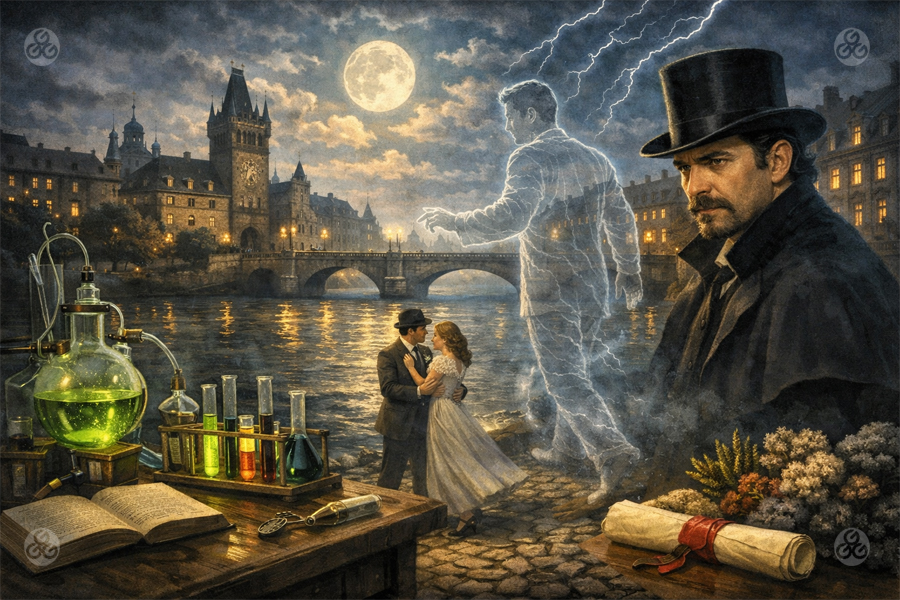
Among Jules Verne’s lesser-known novels, The Secret of Wilhelm Storitz occupies a special place because of its continued relevance in highlighting one of humanity’s enduring problems: the abuse of power.
The story unfolds in Rápol, a fictional Hungarian city, where a reclusive scientist named Wilhelm Storitz terrorizes the population with an inexplicable ability: he can render objects invisible, make himself invisible, and use that power to spread fear while remaining unseen.
Storitz employs his invisibility to spy on others, manipulate events, and ruin the lives of those around him, particularly that of the young Myra Roderich, whom he seeks to make his own. The novel offers a disturbing reflection on how knowledge without ethics can become a form of tyranny. Storitz is a tragic character—brilliant, yet incapable of forming meaningful connections with others. His extraordinary power only deepens his isolation.
Most readers believe that H. G. Wells invented the Invisible Man in 1897. In fact, Verne had written this manuscript years earlier, although it was not published until 1910, after his death. The difference is that while Wells uses invisibility as a vehicle for chaos and violence, Verne turns it into a “tragic metaphor for the solitary genius and obsession.” Here, Verne does not celebrate technology; instead, he portrays it as a curse. The tension steadily builds toward a dark and surprising conclusion.
The Secret of Wilhelm Storitz is a short, intense, and highly cinematic work that differs markedly from many of Verne’s other novels. It reads almost like a psychological thriller. Readers expecting submarines, balloons, or grand scientific expeditions may be surprised. In this novel, Verne ventures into Gothic fiction, psychological horror, and romantic drama. Its uniqueness within his body of work makes it an excellent conversation piece.
It is important to recognize that this is not a flawless masterpiece. At times, the pace slows because of lengthy descriptions, and the female protagonist, Myra, remains somewhat passive. Yet it is precisely these imperfections that make the novel particularly rewarding for attentive readers and scholars of the great French writer’s work.
Jules Verne, born Jules Gabriel Verne, was a French novelist, playwright, and poet best known for his adventure stories and for his profound influence on the science fiction genre. In addition to his novels, he wrote plays, short stories, autobiographical sketches, poetry, songs, and scientific, artistic, and literary studies. His works have been adapted for film and television, as well as graphic novels, opera, music, and even video games.
Verne was born on February 8, 1828, in Nantes, then part of the Kingdom of France. When he died on March 24, 1905, in Amiens, he had published 62 novels, around 20 short stories, 10 plays, approximately 39 poems, and 12 essays and other nonfiction works.
Readers interested in The Secret of Wilhelm Storitz in Spanish can download a PDF edition from the following website:
The document also includes notes and background information that may prove of interest to readers seeking additional context about the novel.
Translated by Luis E. Amador Dominguez