Spanish Without Borders: A Language Celebrating Its Vitality in a Diverse World
Every April 23, the Spanish language puts on its finest attire. Established by the United Nations in 2010, the date pays tribute to Miguel de Cervantes, who died on this day in 1616. Yet the commemoration goes far beyond honoring the author of Don Quixote; it has become an occasion to reflect on the vitality of a language spoken by more than 500 million people across four continents.
The significance of Spanish Language Day lies not only in the numbers—impressive as they are. According to the Cervantes Institute Yearbook (2023), Spanish is the world’s second-most widely spoken native language, surpassed only by Mandarin Chinese. In addition, nearly 24 million people study it as a foreign language. In an interview last March, the Institute’s director noted: “We are not celebrating a dead language or a fixed heritage. We are celebrating a vehicle of cultural and economic creation that grows every year in the United States, Brazil, and sub-Saharan Africa.” This observation challenges the notion of Spanish as a language confined to Spain or Latin America.
Elena Rojas, a researcher at the University of Buenos Aires, argues that the celebration serves both political and symbolic purposes. “At a time of identity-based polarization, Spanish Language Day reminds us that we share a grammar, a syntax, and an immense literary heritage. That does not negate local diversity.” She points to Spanish in the United States, where more than 40 million people use it daily: “Works are being created there in Spanglish or in neutral Spanish, and that is richness, not degradation.”
Another authoritative voice is Colombian novelist Juan Gabriel Vásquez, winner of the Rómulo Gallegos International Novel Prize. In a lecture at the Bogotá Book Fair in 2022, Vásquez observed: “Cervantes gave us a language for irony and doubt. That is why every April 23 we should read aloud—not to make ourselves uniform, but to listen to the different accents of a single language.” His words underscore the polyphonic nature of Spanish, from the voseo of the Río de la Plata region to Andalusian seseo, and from Mexican yeísmo to other forms of spoken expression, highlighting how the celebration becomes a dialogue among traditions.
Not everything, however, is cause for enthusiasm. Some specialists warn of the risks of institutionalizing the date. Spanish philologist Antonio Muñoz Molina, in an article published in El País in April 2023, criticized certain commercial uses of the observance: “The danger is turning the language into a brand, into an export product emptied of content.” While acknowledging the commendable efforts of the Royal Spanish Academy (RAE) and the Association of Academies to unify standards, he insists that a living language is not decreed—it is spoken. His position calls for a celebration that is more critical and less folkloric.
From a statistical perspective, the Cervantes Institute report Spanish in the World (2022) offers compelling figures: Spanish has 493 million native speakers, while the total number of potential users, including those with limited proficiency, exceeds 591 million. Online, it is the third-most widely used language, accounting for 8% of users. These data reinforce the idea that the celebration is not a nostalgic exercise, but a barometer of contemporary reality. As Carolina Díaz, a linguistics professor at the University of Salamanca, put it: “Every April 23, we should also be discussing language policies, speakers’ rights, and the future of Spanish in the age of artificial intelligence.”
For that reason, International Spanish Language Day goes beyond a simple tribute to Cervantes. It represents a meeting point for a diverse community, often dispersed by migration and history. The celebration reaches its fullest meaning when citizens, writers, and scholars use it to ask not only what we are as Spanish speakers, but what we aspire to become. Far from being a fixed monument, Spanish reveals itself as a river with many outlets. The press, the classroom, and everyday conversation thus become the main stage for this borderless celebration because, as Nicaraguan poet Rubén Darío once said, “language is the soul of a people.” And that soul beats every day, not only on the calendar.
Translated by Luis E. Amador Dominguez
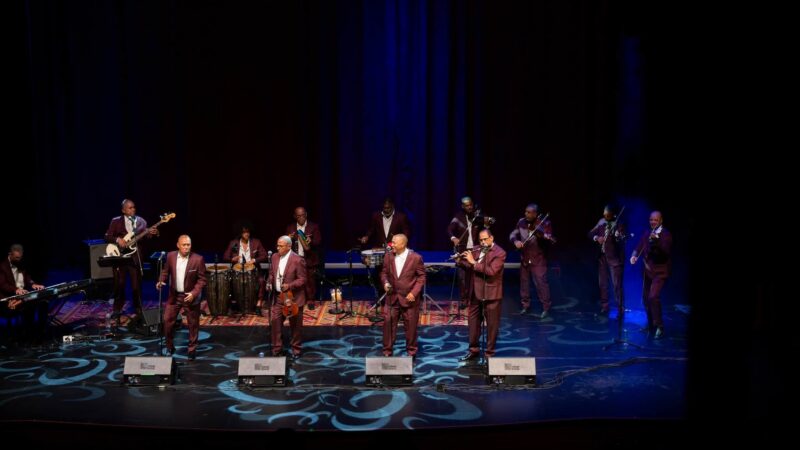
Photo: The Spanish Group