The House of All: A Beacon of Cultural Integration in Havana
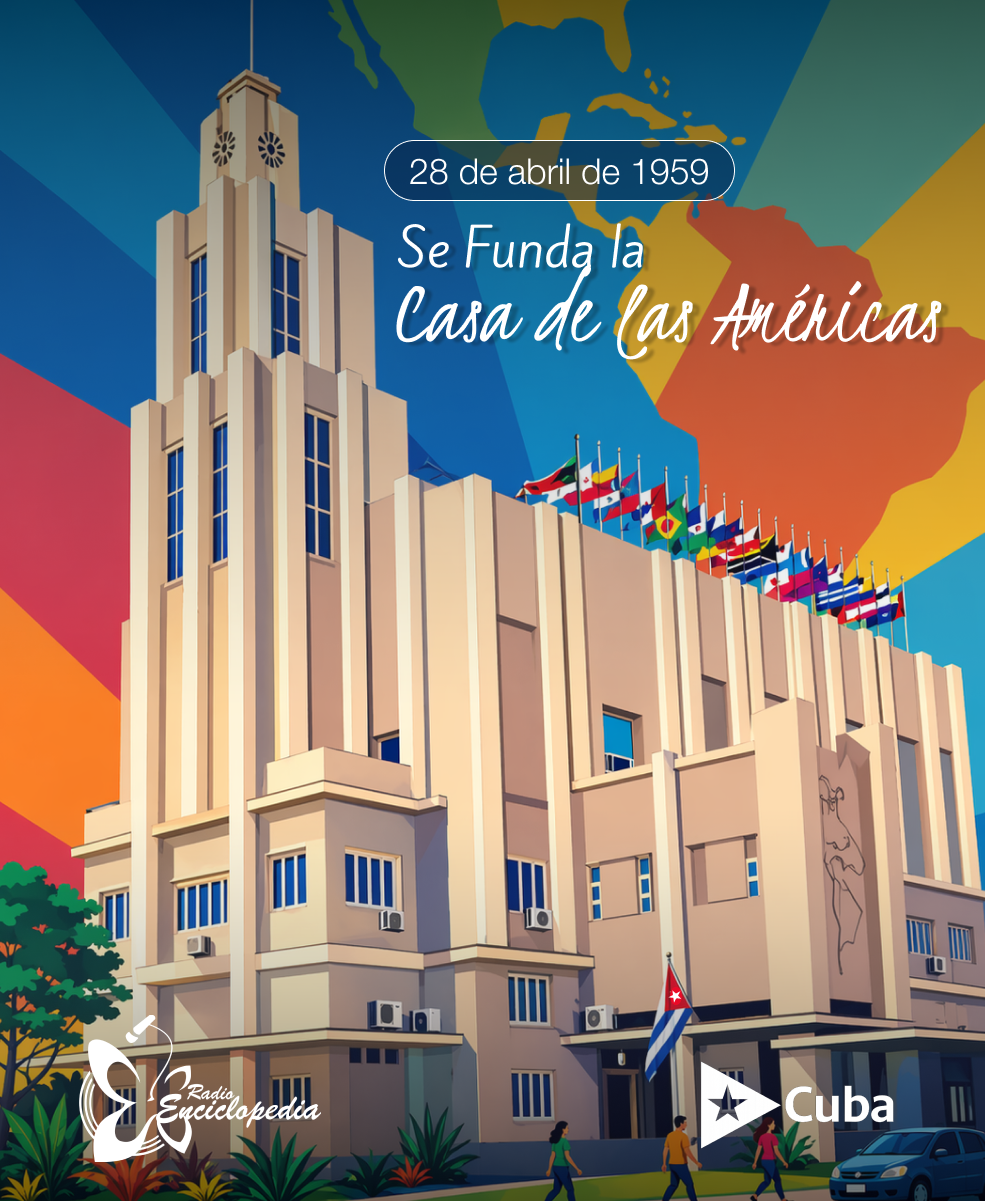
In Havana’s Vedado district, just a few meters from the Malecón, stands a white mansion whose work reaches far beyond its physical walls. It was 1959, barely four months after the triumph of the Cuban Revolution, when the Revolutionary Government enacted Law No. 229 on April 28. On that day, Casa de las Américas was born—an institution conceived not as a mere repository of art, but as a trench of ideas aimed at strengthening the bonds of a fractured region.
The founder of this endeavor was Haydée Santamaría Cuadrado, a woman whose biography includes the assault on the Moncada Barracks and the struggle in the Sierra Maestra. As the poet Eliseo Diego described her, she was a country girl who did not fear approaching that which exceeds the measure of man. Under her leadership, which lasted until 1980, the Casa became the principal catalyst for Latin American and Caribbean unity. Its physical headquarters opened its doors on July 4 of that same year, in a ceremony presided over by then Minister of Education Armando Hart Dávalos, in what had previously been the Continental House of Culture.
When most governments in Latin America, with the sole exception of Mexico, yielded to pressure from the United States to break diplomatic relations with the Island, Casa de las Américas acted as a cultural lifeline. Commander in Chief Fidel Castro himself acknowledged at the First Congress of the Communist Party of Cuba in 1975 that the institution helped prevent cultural isolation during the most difficult years of the blockade.
The Uruguayan writer Mario Benedetti, an indispensable voice of the continent, summarized this phenomenon with striking clarity: “Thanks to the Casa, the creators of Latin American arts and letters were not only able to reach the Cuban people and come into contact with the irreplaceable reality of the Revolution; we were also able to know and recognize one another among ourselves.” This sentence captures the institution’s founding spirit: to break the isolation suffered by creators, who according to Benedetti often knew more about what was being produced in Paris or New York than about the work of their neighbors in Mexico or Argentina.
One of the most effective tools for achieving that mutual recognition has been the Casa de las Américas Literary Prize. Created in 1960, this award became a barometer of the continent’s literary quality and a launching platform for authors who, over time, would become giants of world literature. The Argentine writer Julio Cortázar, a frequent and beloved visitor to the institution, noted that the work of Casa de las Américas takes on a significance that no praise could fully encompass, and that far exceeds its brief institutional life.
Cortázar added a crucial observation about the expansion of its influence: “In recent years, the cultural reach of the Casa has multiplied (…) even in some centers whose ideological line differs from the Cuban one, but which can no longer ignore the quality and validity of the intellectual production that the Casa channels.” This statement underscores the institution’s ability to place artistic quality above political orthodoxy—an equilibrium that has not always been easy to maintain.
The Cuban critic and essayist Roberto Fernández Retamar, who directed the Casa for more than three decades until 2019, often said that the institution found its nourishment in the thought of Bolívar, Sandino, and especially José Martí. The Casa did not limit itself to fiction; in 1970 it opened its doors to testimonial literature and later created categories devoted to Indigenous cultures, women’s studies, and Caribbean literatures in English, French, and Creole.
Beyond literature, the reach of the Casa extended to every manifestation of the spirit. The Visual Arts Department, created in 1961, made possible the formation of the Haydée Santamaría Art of Our America Collection, a visual archive of more than 10,000 works now exhibited in its galleries. At the same time, the Music Division, founded in 1965, and the Center for Caribbean Studies (1979) consolidated a model of a multifunctional institution.
The current president, the poet and essayist Abel Prieto, who assumed the position at the end of 2019, has continued this work in a context of intensified economic measures against Cuba. Prieto, together with figures such as Miguel Barnet and Nancy Morejón, has signed international appeals in defense of the Island’s cultural sovereignty, showing that the Casa’s vocation for resistance has not diminished over the decades. It remains a space for complex and necessary dialogue—not a museum of the past, but a living idea that reminds the continent that its greatest wealth lies in its shared diversity.
Translated by Luis E. Amador Dominguez