An October 2 That Shaped the Course of Spanish Language in Cuba
Cuban culture has dates that serve as turning points in its history. One such date is October 2, 1926. On that Saturday in Havana, the Cuban Academy of the Language was formally established as a corresponding academy of the Royal Spanish Academy. The gathering was far more than a bureaucratic formality. It represented the fulfillment of a long-cherished aspiration among a group of intellectuals who regarded language as a cornerstone of national identity. The institution had been approved in Madrid on May 19 of that same year, but it was in the Cuban capital that it effectively began its work, according to the academy’s official history.
The context in which the Academy was founded explains much of its raison d’être. Cuba was living under a constrained republican system, with a U.S. presence that permeated not only the economy and politics but also everyday language. The press of the time displayed an influx of foreignisms that concerned the more discerning members of the intellectual community. In that climate, the founding of a national academy was not an isolated exercise in scholarship, but a cultural bulwark. Its stated aim was to safeguard the development and preservation of Cervantes’s language in the largest archipelago in the Antilles.
The founding effort had a diplomatic driving force. Cuban writer Manuel Serafín Pichardo, who held a position at the Cuban Legation in Madrid, undertook the necessary démarches with the Royal Spanish Academy to secure approval for a corresponding academy on the island. The affirmative response came on May 19, 1926. Cuba thus became the thirteenth corresponding academy of the Spanish institution, in recognition of the country’s cultural vitality and the depth of its literary tradition.
However, the date the institution commemorates most prominently is October 2. On that day, eighteen founding members met at the headquarters of the Academy of History in Old Havana. Diario de la Marina, in its October 4, 1926, edition, recorded the event: “Last Saturday, October 2, this Academy was formally constituted, with all its members in attendance except Messrs. Mariano Aramburo, José M. Carbonell, Carlos M. Trelles, and Fernando Figueredo, who were unable to attend for various reasons.” The report adds that the Academy’s director, philosopher and writer Enrique José Varona, “(…) spoke briefly about the importance to Cuba of the creation of this Academy and called upon everyone to cooperate in fulfilling the purposes for which it had been established.”
The constitutive meeting went beyond speeches. The founders made important organizational decisions. They elected Varona as the Academy’s first director, a position he held until 1933. Fernando Ortiz was appointed deputy director, and Antonio L. Valverde secretary. They also approved the creation of a commission charged with drafting the statutes and regulations of the new institution. The commission consisted of Fernando Ortiz, Antonio Sánchez de Bustamante, and Francisco de Paula Coronado. The regulations were completed in 1927, enabling the Academy to begin operating on a regular basis.
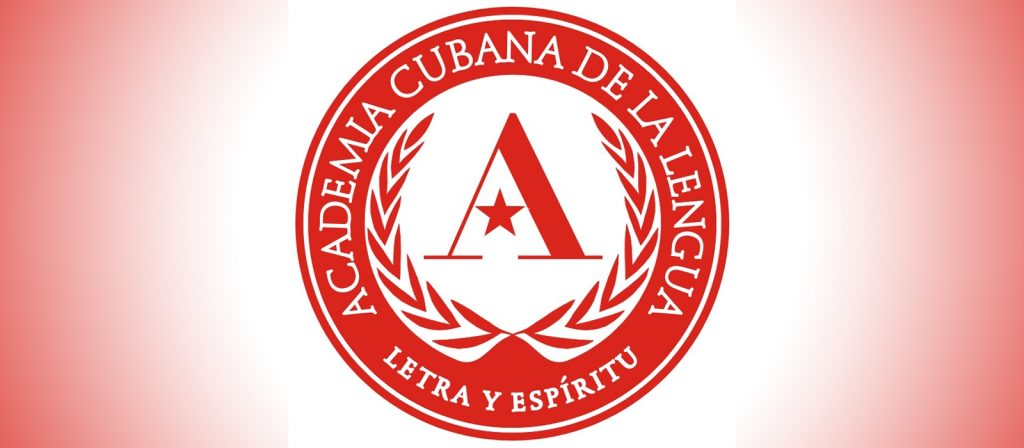
Throughout its history, the Academy has counted among its members figures whose influence extends far beyond the strictly linguistic sphere. In 1957, poet Dulce María Loynaz became the first woman elected as a full member. Years later, she would also become the institution’s first female director, a distinction she shares only with Nancy Morejón. Writers, critics, linguists, and professors have occupied its seats, contributing to what the institution itself defines as its mission: promoting, cultivating, and perfecting the Spanish language, particularly in its Cuban variety. The Academy’s motto, “Letter and Spirit,” was adopted in 2004 and is engraved on its academic medal. It was coined by journalist and Doctor of Philosophy and Letters Delio Juan Carreras.
The institution has gone through periods of varying degrees of public visibility. For decades, its work was carried out quietly, at times with a conspicuous absence from the media. Its advisory role, however, has remained relevant. The Academy provides a language-consultation service for resolving linguistic questions and has published a bulletin since 1952, compiling the works published by its members, admission speeches, and news about its activities.
With the passage of time, the anniversary of October 2, 1926, has taken on a significance that its protagonists may not have fully foreseen. Those eighteen men—and men alone, at the time—who gathered at the Academy of History did more than establish a linguistic institution. They created a space for cultural resistance in the face of external pressures and a means of reflecting on the language from Cuba and for Cuba. A century later, the Cuban Academy of the Language continues to fulfill that mission, now with a headquarters of its own, with women among its members and in its leadership, and with the challenge of accompanying the evolution of the Spanish language in a world where the boundaries of the language continue to expand and diversify. October 2 is not merely a date on the institutional calendar; it is a reminder that language is safeguarded through institutions and collective memory, in the conviction that words, too, help build a nation.
Translated by Luis E. Amador Dominguez
Photo: La Jiribilla