Fidel and the Extraordinary Value of His Political Thought
The wealth of teachings left by Commander in Chief Fidel Castro is inexhaustible and continues to grow richer as his thought and work are studied in greater depth, above all because of his ability to analyze, anticipate, and envision the future.
These teachings were not addressed solely to individuals and peoples; they have also served as fertile ground for political and social struggles around the world. His political ideas should be a permanent source of reference for all, particularly when it comes to understanding the reasons behind a struggle, confronting difficulties and achieving victories, analyzing the causes of setbacks, identifying what is essential in each situation, devising strategies and tactics, and making decisions.
From a very young age, he displayed remarkably profound political thinking, courageously and defiantly confronting every form of domination. Over time, that thinking evolved into a more mature and far-reaching vision, developed from the vantage point of revolutionary power.
He drew on the legacy of his predecessors, above all the thought of José Martí, Carlos Manuel de Céspedes, and Julio Antonio Mella, to analyze the era in which he lived. But he also drew on revolutionary practice under the most difficult conditions of student and insurgent struggle, and later, following the triumph of the Revolution. He studied the works of Karl Marx, Friedrich Engels, Vladimir Ilyich Lenin, and other classical thinkers, adapting their principles to Cuba’s conditions.
He became a young, resolute student and political activist, fully aware that seizing political power was necessary if the country’s destiny was to be transformed. Later, he became an example of a permanent revolutionary: a tireless fighter in the battle of ideas through speeches and reflections, as well as through direct contact with the Cuban people; and a dedicated student of a wide range of essential issues for the benefit of his people and humanity.
His political thought, profoundly rooted in Martí’s ideas and characterized by its revolutionary, anti-imperialist, and socialist outlook, was enriched by countless experiences and became increasingly radical. It has constituted a significant contribution to the history of the homeland, together with his extraordinary moral and human qualities.
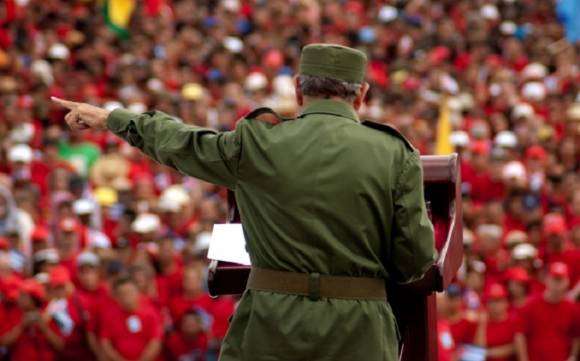
He also used his magnificent oratorical skills to argue, convince, persuade, guide, and mobilize the masses through solid and up-to-date arguments that became irrefutable and strengthened the convictions of many people around the world.
Through the struggle and the constant political action of Fidel and the other leaders of the Revolution, the supreme values of the Cuban people became increasingly firmly rooted, elevating them to a higher level in the defense of a country that has been constantly threatened militarily, subjected to an economic, financial, and commercial blockade, and placed under an unprecedented energy siege. These values are patriotism, identity, and national consciousness, all grounded in three essential virtues: human dignity, uncompromising opposition and intolerance toward every form of foreign domination, and solidarity.
The Cuban people continue to hold Fidel deeply dear.
Translated by Luis E. Amador Dominguez
Photo: Roberto Chile / Cubadebate