Heredia: Cuba Invented Through Nostalgia
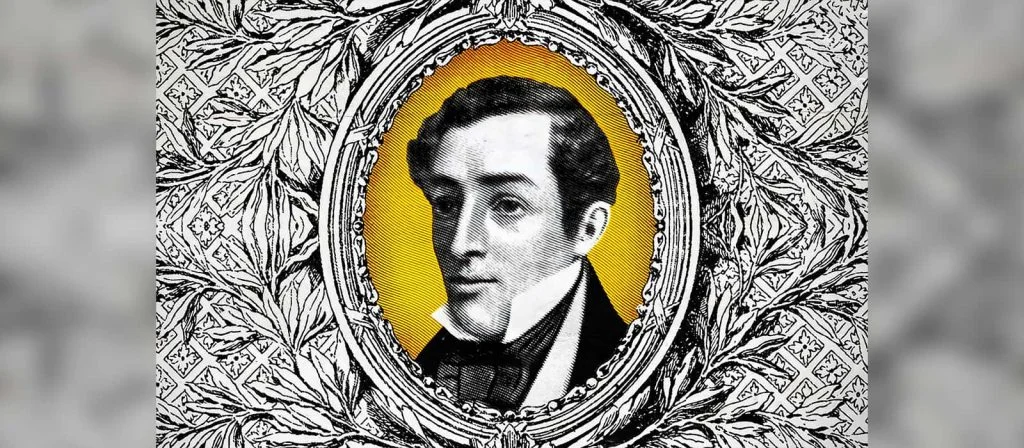
On the afternoon of May 7, 1839, in a back room at 15 Hospicio Street in Mexico City, tuberculosis claimed the life of José María Heredia. He was 35 years old and had already produced a body of work that ushered Romanticism into Spanish American literature. His death, like much of his life, unfolded in bureaucratic silence: the day after his burial, the Diario del Gobierno — where Heredia had overseen the literary section until just a week earlier — published a notice seeking to fill his vacancy. There was no obituary, only a routine announcement.
The news was slow to cross the Gulf. By the time it reached Cuba, it was understood differently: the man had died, but a foundational symbol had been born. José Martí, who a decade later would recognize in Heredia’s verses the source of his own liberating vocation, wrote: “Heredia was perhaps the one who awakened in my soul, as in the souls of all Cubans, the inextinguishable passion for freedom.” In that line lies the legacy of a writer who conceived poetry as a surrogate homeland.
The son of Dominican parents, Heredia was born in Santiago de Cuba on December 31, 1803. Precocity marked his early years: by age eight he was translating from Latin and French; at 17 he wrote “En el Teocalli de Cholula,” a poem critics regard as the turning point between Neoclassicism and Romanticism in the Spanish language. But his creative momentum was overtaken by political turmoil. In 1823, implicated in the pro-independence conspiracy Soles y Rayos de Bolívar, he fled through the port of Matanzas disguised as a sailor. It was the beginning of an exile that would last for most of his life.
His years in exile were divided between the United States and Mexico. In 1824, before Niagara Falls, he wrote the ode that would establish him as the Bard of Niagara. The poem, included by critic Marcelino Menéndez y Pelayo among the 100 most important works of Spanish lyric poetry, moves between the force of untamed nature and an evocation of Cuba’s palm trees. From that fusion emerged one of the island’s defining emblems: the royal palm as a national symbol, later incorporated by Miguel Teurbe Tolón into the design of the coat of arms.
Mexico, his second homeland, offered him refuge and responsibility. Heredia headed the Literary Institute of the State of Mexico — a precursor to today’s Autonomous University of the State of Mexico — and published there the first universal history in Spanish to be printed in the Americas. He served as a legislator, prosecutor, judge, and newspaper editor. Yet neither public office nor academic life could dull the sting of absence. During a sea voyage in 1825, as he caught sight of the Pan de Matanzas from the schooner carrying him away from Cuba once again, he composed the “Hymn of the Exile,” which independence fighters would later sing during the 19th-century wars as an unofficial anthem of the nation yet to come.
In 1836, after writing a public letter retracting his independence ideals, he obtained permission to return to the island. The visit lasted four months. His former comrades, led by Domingo del Monte, condemned the recantation and kept their distance. Heredia returned to Mexico in deep despondency, according to contemporary accounts, and died there three years later in poverty.
Even his remains endured a posthumous diaspora. First laid to rest in the cemetery of the Santuario de María Santísima de los Ángeles in Mexico City, they were transferred to Cuba in 1844, to Santa Paula Cemetery. When that necropolis was closed, the remains were moved again, this time to Tepellac Cemetery, where their location was lost in a common grave. The paradox is complete: the poet who sang of exile has no identifiable tomb.
His work survived the dispersal of his bones. The critical edition of his Poesías completas, published in 2020, confirms the enduring vitality of a voice that Cintio Vitier described as the first lyrical embodiment of the nation as a necessity of the soul. Heredia inaugurated on the continent a poetry that does not confine itself to landscape or intimate confession, but instead turns exile into a form of belonging. Cuba, for him, was a creation shaped from afar, and that literary invention proved more powerful than physical presence.
One hundred and eighty-seven years after his death, the poet rests in Mexican soil — that Nuestra América he also helped imagine. There is no gravestone marking the exact spot, but there remains a tradition of readers who, like Martí, felt the spark of freedom in contact with his verse. Heredia died without money, without office, without the recognition of his Cuban peers, and without a tangible homeland. Perhaps for that very reason he founded one more enduring: the homeland that exists in language, where the force of his “Oda al huracán” still blows with the same strength.
Translated by Luis E. Amador Dominguez
Photo: Cubaperiodistas