Manuel Corona: The Living Memory of Cuban Trova
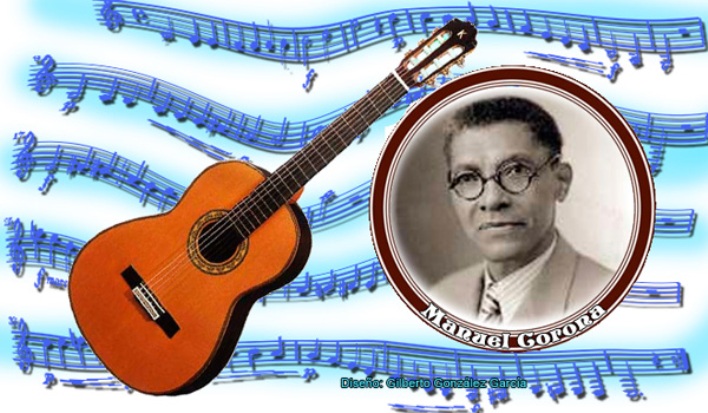
Manuel Corona Raimundo was born in Caibarién, Las Villas Province, on June 17, 1880. Of Afro-Cuban and Chinese ancestry, he arrived in Havana after the War of Independence and found work as a supervisor in a cigar factory. His true calling, however—the one that would remain with him until his final breath—was music.
Corona enjoyed gathering at family soirées, where he displayed his gifts as a musician and composer. He also frequented Havana’s red-light district, particularly the San Isidro neighborhood, an area populated by prostitutes and pimps and viewed with disdain by the moral establishment of the time. Corona, however, transformed that marginal world into a lyrical landscape. From it emerged songs that are now classics of the Cuban musical canon: Longina, Santa Cecilia, La Alfonsa, Aurora, and Una mirada, along with guarachas such as El servicio obligatorio and Cómo está Lola.
Music critics have long argued that reducing Corona to a mere chronicler of bohemian life is a mistake. Journalist and critic Pedro de la Hoz, in his analysis of Santa Cecilia, noted that while the song celebrates feminine beauty through imagery characteristic of Cuba’s lyrical imagination of the period, “the music goes much further. The design of the song’s two melodic lines is challenging and demands a refined vocal performance in its original conception, comparable to Perla marina and El huracán y la palma by Sindo Garay.”
Such observations place Corona in a technical dimension that few have fully acknowledged. He was not simply an intuitive songwriter from the streets; he was a master craftsman of melody and harmony.
Along the same lines, journalist Jorge Rivas has pointed out that Santa Cecilia reveals Corona’s command of melodic figurations, harmonic progressions, and compositional techniques, all handled without ever compromising musical syntax. Rivas adds a detail that dismantles the stereotype of the careless bohemian: “The harmony is precise and effective, both in its tonal and extratonal chords, and its resolutions are regarded by critics and specialists as technically sound.”
Corona trusted his talent and showed little interest in financial gain or the trappings of the entertainment industry. That personal choice condemned him to obscurity during his lifetime but secured his place in posterity.
One of the most fascinating aspects of his career was his fondness for answer songs. Within the Cuban trova tradition, composers often responded to one song with another, whether as a rebuttal, a challenge, or a gesture of artistic rivalry. Corona mastered the form. Thus emerged Ausencia sin olvido, written in response to Jaime Prats’ Ausencia; Gela amada, a playful answer to Rosendo Ruiz’s Gela hermosa; Animada, composed as a reply to Patricio Ballagas’ Timidez; and La habanera, written in response to Sindo Garay’s La bayamesa.
These friendly rivalries reveal not only Corona’s wit but also the vitality of a creative community whose members engaged one another through song.
Yet Manuel Corona’s name remains forever linked to a single composition: Longina. The story behind this bolero—the most recorded song in his repertoire—reads like a novel by Alejo Carpentier.
Its muse was Longina O’Farrill, a woman of mixed African and European ancestry renowned for her striking beauty, who captivated politician and patron Armando André Alvarado. Popular legend has portrayed the song as the troubadour’s impossible love for Longina, but documentary evidence tells a different story. María Teresa Vera, Corona’s closest artistic counterpart and lifelong friend, maintained that the song was commissioned. According to her account, Armando André, eager to flatter his companion, challenged Corona to write a song in her honor.
“Come back on the fifteenth and you will hear it,” the troubadour reportedly replied.
Thus was born the immortal Longina, premiered on October 15, 1918, in the solar known as La Maravilla, in a poor yet vibrant Havana. Years later, Longina O’Farrill herself dismissed the romantic legend. “He immortalized me,” she said gratefully, but without any hint of the passion later attributed to the relationship.
The anecdote reveals much about Corona’s character. He was a fixture of Havana’s nightlife, a man who understood that a well-crafted song could pay for the next round.
Musicologist Odilio Urfé regarded Corona as one of the five great classics of the genre, alongside Pepe Sánchez, Sindo Garay, Rosendo Ruiz Suárez, and Alberto Villalón. Urfé argued that the success of Doble inconsciencia, composed in 1900, led to Corona’s emergence as a major figure of the Cuban songbook, not only across the island but also throughout Latin America and among the large Latino communities of North America during the 1910s.
The numbers bear out that assessment. Combining the works credited to Manuel Corona and those published under José Corona—a pseudonym he used to circumvent exclusivity clauses imposed by record companies—he became the most widely recorded composer in the trova repertoire during the first decades of the twentieth century.
The oblivion Corona anticipated in his lyrics never truly came to pass. Music critic Ángel Vázquez Millares described him as “the most passionate minstrel of Cuban womanhood.” The description rings true. Corona composed dozens of songs dedicated to women who captivated him. Among them, Longina, Santa Cecilia, and Mercedes were popularized by another indispensable figure of Cuban trova: María Teresa Vera, whose crystalline voice carried Corona’s music across the continent.
The final chapter of his life, however, was a harsh one. At Havana’s Jaruquito cabaret, he once asked the owner to let him rest in a storage room filled with empty bottles. There, in a dark and cold corner, he was found dead, a victim of tuberculosis, alcoholism, and malnutrition.
The date was January 9, 1950. Cuban music had lost one of the founding fathers of its popular song tradition, yet the news occupied only a few lines in the newspapers.
Translated by Luis E. Amador Dominguez