The Voice That Came Through the Air: The Founding of Radio in Cuba

On August 22, 1922, at nine o’clock at night, a voice emerged from the ether and forever changed Cubans’ relationship with information, entertainment, and culture. That first broadcast by station 2LC, operated by engineer Luis Casas Romero from a modest studio set up in his own home at 57 Animas Street in Havana, inaugurated Cuban radio broadcasting and laid the foundations for a tradition that, a century later, remains an essential part of the island’s soundscape. Journalist and researcher Mayra Cue Sierra, one of Cuba’s most rigorous historians of the medium, has noted: “(…) the founding of radio in Cuba was neither an isolated event nor a technological whim, but the culmination of a long process of experimentation in which self-taught engineers, visionary musicians, and an audience eager for new forms of communication came together.”
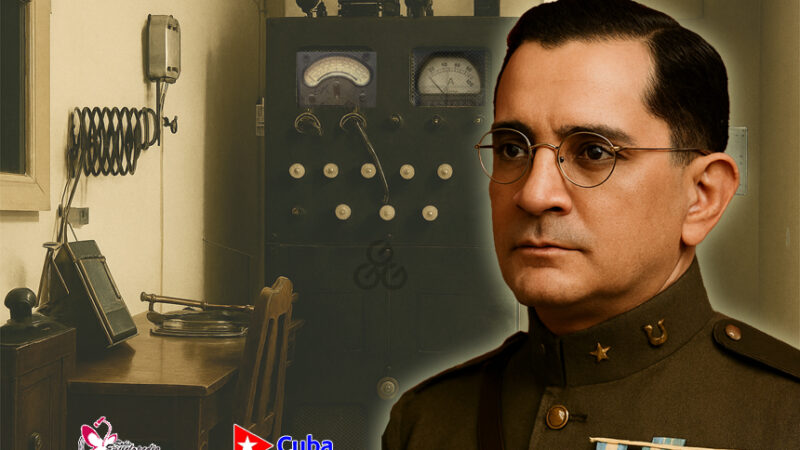
Luis Casas Romero deserves to be remembered as more than a pioneer. A composer, flutist, and bandleader, Romero had fought in the War of Independence and understood, as few others did, the strategic value of communications. Upon returning to civilian life, he combined his passion for music with an almost obsessive curiosity about advances in radiotelegraphy. In 1921, he obtained permission from the government of Alfredo Zayas to install an experimental radio station, and for months he worked on the handcrafted construction of the equipment with the help of his children and a small group of collaborators. Researcher José Altshuler, in his thoroughly documented history of science and technology in Cuba, points out: “(…) Casas Romero’s feat consisted not only in being the first, but in accomplishing it with almost household resources, in a country that lacked an electronics industry and where the very concept of broadcasting was still an oddity to most people.”
The programming on that inaugural night was, fittingly for a musician, primarily artistic. Casas Romero himself performed several pieces on the flute, his daughter Zoila sang a number of popular melodies, and news of the day was broadcast after being read into a rudimentary microphone. What today might seem like an amateur undertaking was, at the time, an event that immediately aroused curiosity. The few owners of crystal radio receivers—those primitive devices that operated without electricity, using a lead sulfide crystal as a detector—gathered around their earphones to listen to this marvel, and it was not long before the first radio enthusiasts began building their own sets from improvised parts. From its very beginnings, radio in Cuba was a phenomenon of popular appropriation rather than a luxury reserved for the elites. Essayist and journalist Aida Calviac observes: “(…) while in other countries radio began as a business dominated by large corporations, in Cuba it was initially a handcrafted, almost intimate endeavor that connected the inventor with a small group of fellow listeners. That origin shaped the close, family-like character that Cuban radio would retain for decades.”
The subsequent development was swift. In October 1922, barely two months after 2LC’s first broadcast, PWX went on the air, a more powerful station installed by the Cuban Telephone Company with government support. Among other things, the station broadcast a message from President Zayas and a concert that could be heard across much of the national territory. The road to commercial radio was now open, and throughout the 1920s dozens of stations emerged in Havana and the country’s major inland cities. Musicologist and broadcaster Orlando Castellanos has underscored a fundamental aspect of this expansion: “Cuban radio did not limit itself to reproducing formats imported from the United States. From very early on, stations incorporated Cuban popular music, homegrown humor, radio dramas, and programs featuring public participation. Alongside the newspaper, radio became the great medium for constructing a national public sphere.”
The 1930s consolidated the golden age of Cuban radio. Stations competed for audiences with programming that included live orchestras, comedians, reciters, contests, and, above all, radio soap operas that brought the country to a standstill during their broadcast hours. Titles such as El derecho de nacer, by Félix B. Caignet, achieved levels of popularity that are difficult to imagine today: when the final episode aired, the streets were deserted, and even movie theaters suspended their screenings. Researcher Mirta Muñiz Egea, in a now-classic study of the Cuban radio soap opera, maintains: “(…) that phenomenon was not merely a ratings success but a cultural event of the first magnitude. The radio soap opera educated the Cuban ear in matters of sentiment, created a shared language of emotions, and built a repertoire of characters and situations that television and cinema would later inherit.”
Not everything on that pioneering radio was light entertainment. From its earliest years, the medium also hosted political debates, educational programs, and cultural stations that, like the legendary CMQ Radio, maintained ambitious programming encompassing concert music, radio theater, and lectures by intellectuals. Radio became a forum and a school, a secular pulpit and a public square. Historian and essayist Rafael Lam notes: “(…) many of the great Cuban musicians of the first half of the twentieth century—Ernesto Lecuona, Rita Montaner, Miguel Matamoros—built their fame from behind radio microphones before they did so on stages or through recordings. Radio did not reflect the country’s musical reality: it created it.”
The triumph of the Revolution in 1959 ushered in a new stage in the history of the medium, marked by the nationalization of radio stations and their conversion into instruments of a political and cultural project. Radio became ubiquitous, free of charge, and deeply intertwined with the country’s institutional life. Provincial and municipal stations emerged, carrying the signal to the most remote corners of the Cuban landscape. Programs such as Alegrías de sobremesa and No hacen falta alas became part of the fabric of collective memory. Broadcaster and researcher Jesús Cabrera, in an assessment of that period, observes: “(…) revolutionary radio had the virtue of democratizing access to information and culture, but it also suffered from the limitations of an excessively centralized model and an aesthetic that often confused political guidance with didacticism. The best of that radio survived in the cracks left open by the individual creativity of its producers.”
The Special Period of the 1990s subjected Cuban radio to an extremely difficult test. The shortage of technical resources, power outages that interrupted broadcasts, and growing competition from South Florida stations, which could be easily picked up on the island, forced a reinvention that had much in common with resistance. It was during those years that live call-in programs emerged, such as Línea directa on Radio Progreso, turning radio into a barometer of social tensions.
Today, more than a century after that first broadcast, Cuban radio faces the challenge of adapting to a media ecosystem radically transformed by the Internet, social media, and podcasts. New generations consume audio content in ways that the pioneers of crystal radio could never have imagined, while traditional stations compete with a digital offering that transcends national borders. Yet it would be a mistake to declare the demise of radio in Cuba. What is taking place, rather, is a metamorphosis.
As another anniversary is commemorated, it is worth recalling that August night in 1922 when Luis Casas Romero played his flute into a precarious microphone without knowing that he was inaugurating a century of shared sounds. In Cuba, radio has been a witness, a companion, a teacher, a source of comfort, and a mirror; it has reported the news of a hundred years, brought to listeners the music that generations danced to and wept over, broadcast dramas that seemed to stop time, and carried speeches that changed history. Its greatest achievement, however, has been this: weaving an uninterrupted conversation among Cubans, a conversation that began with a handful of listeners gathered around a crystal radio set and continues today, multiplied across thousands of voices, through the airwaves and the algorithms of the internet.
Translated by Luis E. Amador Dominguez