Mariano Rodríguez’s Legacy Lives On in the Cubanness of His Roosters and Crowds
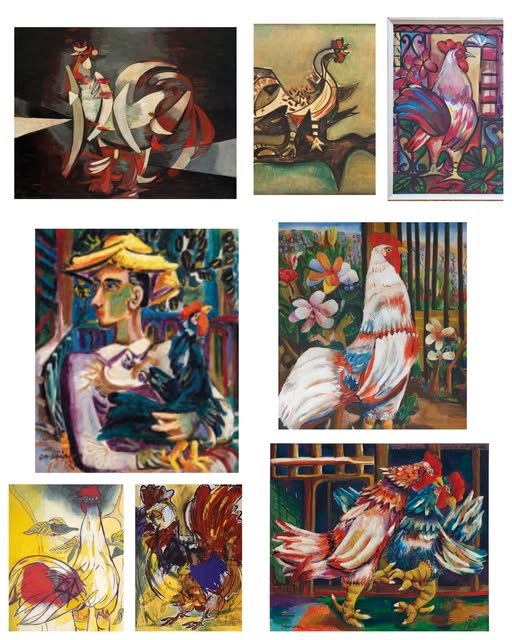
As he sipped his coffee in the patio of his home in Havana’s La Víbora neighborhood, the young painter noticed that a colorful Catalan rooster, which was tethered nearby, was attracting his attention more than usual. With an extraordinary freedom of imagination, he began painting watercolors of it.
It was the beginning of the 1940s, and for Mariano Rodríguez (1912–1990), it also marked the start of a subject that would remain closely associated with him from then on until the end of his life. Yet he would later delve into the heart of another no less compelling subject: the masses of ordinary people—not as they were portrayed by some painters of his time, as alienated, propagandistic figures or people fleeing, but as they appear in Cuba, united and displaying an extraordinary political consciousness.
His mother never discouraged her son’s passion for painting. Encouraged by friends and inspired by the impact of the first exhibition of contemporary painting held in Havana after the fall of President Gerardo Machado, he left for Mexico in 1935, following a brief period of study at the San Alejandro Academy, to study muralism, influenced by the talk of this emerging art form as revolutionary painting in the Americas.
Muralism demanded a firm, disciplined hand in drawing, a path along which Mariano was already confident. As he developed this subject, he also began examining his own expressive sensibility, which enabled him to perceive changes in the visual arts, as he did when he ventured into Abstract Expressionism.
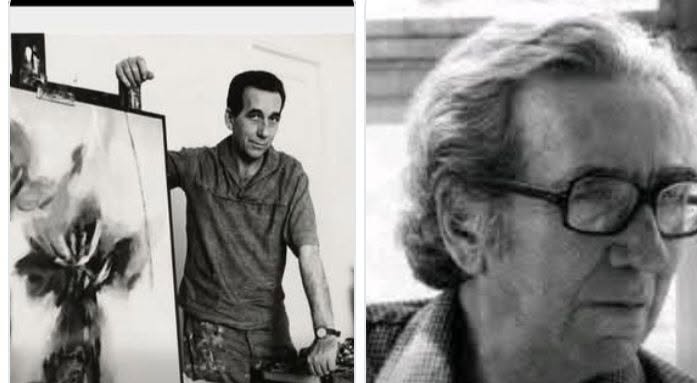
Mariano taught at the Estudio Libre de Pintura, directed by Eduardo Abela, and traveled extensively, but he always returned to his homeland, the Cuba he loved. His desire to live there—a sentiment shared by almost all the artists of his generation—also contributed to his political formation. Unconsciously, like others, he sought a sense of national identity in every painting. He devoted his entire creative imagination to Cuban art.
He had been a member of the Student Left Wing and, upon returning to Cuba, collaborated with the Partido Socialista Popular (PSP). The party needed to raise 100,000 pesos for its campaign for the Constituent Assembly, and Mariano sought the support of artists such as Amelia Peláez and René Portocarrero. They conceived a series of posters, but only Mariano’s was ultimately printed. Its subject was quintessentially Cuban: a peasant with something of a mambí about him, wearing a Cuban flag on his hat.
For many years, he was closely associated with Haydée Santamaría and Casa de las Américas, where he served as deputy director and later succeeded her as director from 1980 to 1986. This brought him into close contact with Latin American culture and contributed to his artistic and intellectual development. Before that, he had been a founding member of the Unión Nacional de Escritores y Artistas de Cuba (Uneac) and had headed its visual arts section.
He always retained his deep love of color and his mastery of it, capturing light through his distinctive way of engaging with reality. There is no doubt that Mariano was a warm and unassuming man, untouched by self-promotion or elitist tastes, who devoted his efforts to the goals he set for himself in his painting. He considered his work optimistic because two things mattered deeply to him: socialism and painting. He admired the way that bringing the two together left no room for despair.
This extraordinary Cuban painter was born on August 24, 114 years ago.
Translated by Luis E. Amador Dominguez