Eternal Fiesta: When Literature Lost Its Last Giant
The early hours of July 2, 1961 marked the abrupt end of a literary era. In Ketchum, Idaho, the sharp report of a Boss 12-gauge shotgun not only shattered the silence of the Rocky Mountains but also tore through the fabric of world literature. Ernest Hemingway, the man who taught writers to stand upright on the page and to live on the edge of the abyss, brought his own myth to its final act with the same resolve with which he once described death in the bullrings of Spain. The news struck Cuba with particular force—the island he called home for two decades and where the legend of “Papa” remains inseparable from the scent of sea air and rum.
Hemingway was not merely a witness to his time; he was an architect of language. His stripped-down prose carved out a new syntax for the twentieth century. Fiesta (The Sun Also Rises, 1926) remains the unintended manifesto of the Lost Generation. In it, he captures the spiritual wound of the postwar world without ever depicting the trenches. Jake Barnes, the narrator emasculated by shrapnel, drifts through a Paris of alcohol and artificial light before colliding with the San Fermín festival in Pamplona. The novel is not a story of action but of existential paralysis, where characters drink to avoid thought and love without consummation. It is a map of desolation disguised as revelry.
To grasp the depth of Fiesta, one must turn to the testimony of his contemporaries. John Dos Passos, close friend and later rival, wrote in his memoir The Best Times that “Hemingway had the strange ability to turn self-pity into a form of classical stoicism.” This is embodied in Jake’s war wound. His physical impotence becomes the central metaphor of a world that has lost its moral compass. The fiesta in Pamplona, with its fighting bulls and red wine, is a pagan ritual that vainly attempts to restore blood and fertility to hollow bodies.
From his refuge at Finca Vigía in San Francisco de Paula, the author not only collected editions of his own work but also absorbed the wisdom of the fishermen of Cojímar. Cuban researcher Enrique Cirules, a leading scholar of Hemingway’s years on the island, documented in Hemingway in the Havana Bay how the writer found in Cuba a virile, elemental landscape that counterbalanced Europe’s decadent sophistication. “He saw in the Cuban fisherman the embodiment of the resilience his Parisian characters had lost in alcohol,” Cirules notes. In Fiesta, however, that primitive stoicism appears only faintly in the figure of the bullfighter Pedro Romero, a shadow of tragic purity set against the disorientation of the expatriates.
The Cuban press reacted to the suicide with a mixture of orphanhood and political critique. The newspaper Revolución, edited by Carlos Franqui, published an editorial on July 3, 1961 lamenting the death of a “sincere friend of the Revolution,” while also underlining the contradiction between the physical courage of his writing and the perceived cowardice of his final act. It is a harsh judgment, yet it reveals the incomprehension that the tormented Hemingway of his final days provoked in an island that had once adored him as a generous, hard-drinking demigod. His estate, with its hunting trophies and books, became a silent shrine—a relic of an emotional empire collapsing while the writer battled electroshock therapy and paranoia.
Literary scholar Ambrosio Fornet, in his analysis of insular narrative, argued in En blanco y negro that Hemingway’s gaze on Cuba lacked the superficial exoticism of other foreigners because he “shared the code of the poor: masculinity as resistance in the face of fate.” Yet that code is fractured in Fiesta. There, fate is not fought; it is endured with clenched jaws and a glass in hand. The Paris of the novel becomes a purgatory from which Hemingway sought his own redemption in the currents of the Gulf Stream.
Sixty-five years after his death, reading Fiesta reveals the essence of Hemingway’s drama: the same as Jake Barnes’s—the relentless search for a cure for a wound that never closes. He applied his famous iceberg principle—leaving seven-eighths beneath the surface—to his own life. He showed the hunts, the fistfights, and the accolades, while concealing a psychological suffering so profound that neither Cuban rum nor writing could numb it. The witness of his time in exile in Idaho closed his own narrative circle with the violence of his earliest pages. As his translator and friend Lino Novás Calvo once wrote, “Hemingway came to literature like a barbarian entering a garden, and in that garden he found death.”
What remains is the work. What remains is that prose that beats like a drum at the San Fermín festival, dialogue as sharp as a blade, and the portrait of a generation dancing over the ruins of history. Hemingway’s final lesson was bitter: the true writer, like the bullfighter in the arena, is always alone before the dark bull of his own conscience. In Ketchum that July morning, it was not defeat that sounded, but the distant echo of a fiesta that, for the rest of the world, has never ended.
Translated by Luis E. Amador Dominguez
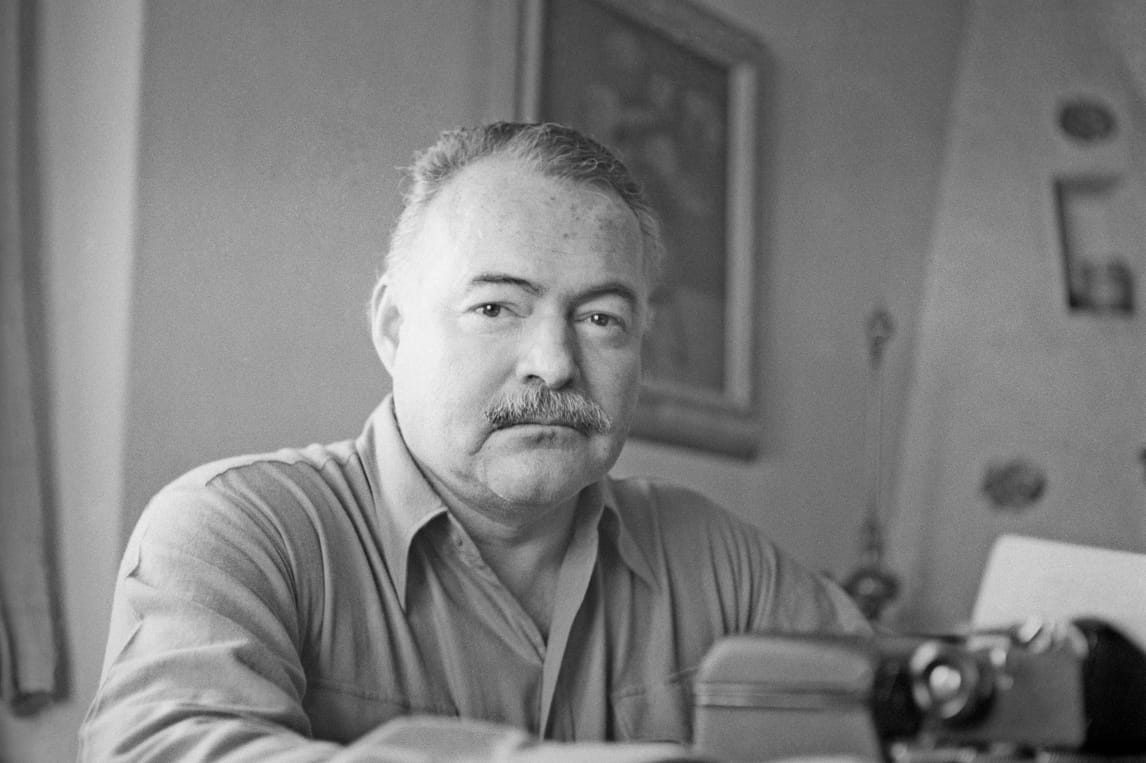
Portrait of American writer and journalist Ernest Hemingway beside a typewriter. Rome, 1949 (Photo by Mondadori via Getty Images). Poetry Foundation.