A Ballet’s Story: From Print to Stage
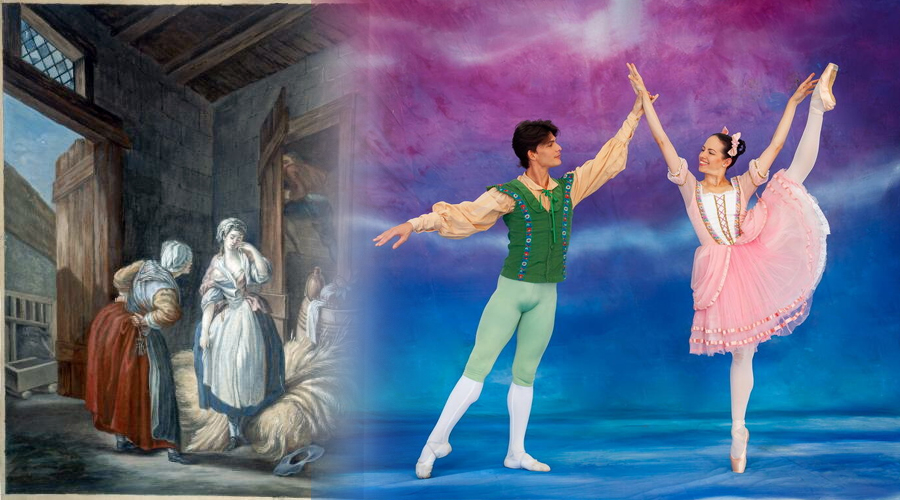
The celebrated ballet La fille mal gardée has an unusual origin, having been inspired by a work of graphic art. According to tradition, the initial idea arose in 1789 when the French choreographer Jean Dauberval saw, in a Bordeaux print shop, an engraving based on a drawing by Pierre-Antoine Baudouin titled La Réprimande or Une jeune fille querellée par sa mère (The Reprimand or A Young Girl Scolded by Her Mother).
The image depicted a young woman being admonished by her mother while her lover fled to hide in a hayloft. This comic, everyday scene captivated Dauberval and became the seed of his choreography.
The ballet—whose title may be rendered as The Poorly Guarded Daughter or The Wayward Daughter—is among the oldest and most beloved works in the classical repertoire. It premiered on July 1, 1789, at the Grand Théâtre de Bordeaux, under the original title Le ballet de la paille, ou Il n’est qu’un pas du mal au bien (The Ballet of Straw, or From Vice to Virtue). Its debut coincided with the dawn of the French Revolution, a moment of profound social change that lent particular resonance to its plot of love between young people of different social standing.
Although the work was revived many times throughout the nineteenth century, the version most widely performed today is that choreographed by Frederick Ashton for The Royal Ballet in 1960. Rich in humor and technical virtuosity, this production revitalized the ballet and is regarded as a cornerstone of the British repertory.
Other renowned choreographers have also left their mark on the piece. Notable versions include those by Marius Petipa and Lev Ivanov (1885, Saint Petersburg); Paul Taglioni (1864, Berlin, with an entirely new score); Alexander Gorsky (1903, Moscow); Bronislava Nijinska (1940, New York); Pierre Lacotte’s historical reconstruction for the Paris Opera (1985); and the emblematic staging by Cuban prima ballerina assoluta Alicia Alonso for the National Ballet of Cuba.
La fille mal gardée is a romantic comedy that celebrates the triumph of true love over imposition and greed. In brief: Lise, a lively and witty young woman, is the daughter of the widowed Simone, a well-to-do and authoritarian farmer who intends to marry her off to a wealthy suitor. Lise, however, is in love with Colas, a humble peasant. Despite her mother’s strict vigilance, she finds ways to meet her beloved. In the end, Simone—moved and resigned—blesses the union, and the ballet concludes with a festive celebration.
In sum, La fille mal gardée is a masterpiece that combines a lighthearted, popular-origin story with brilliant choreography, exalting youthful ingenuity and the victory of love over social convention.
The ballet’s influence has extended beyond dance, leaving echoes in film, theatre, and literature, albeit rarely in a direct manner. In cinema, the silent film The Fickle Girl (1920), starring Olive Thomas, explores a similar dynamic: a young woman torn between a family-imposed suitor and her true love from a humbler background. In musical theatre, The Girl Friend (1926) by Richard Rodgers and Lorenz Hart presents a nearly identical plot set in the 1920s, featuring a heroine who refuses an arranged marriage to a wealthy but inept admirer.
In children’s literature, the ballet inspired the illustrated book La fille mal gardée by Cuban writer and illustrator Leticia Tarragó, which adapts the story for younger audiences. In academic circles, the work is frequently cited in studies on dance history, such as Apuntes sobre la evolución del ballet by Róger Salas, which examines its importance as one of the earliest choreographic comedies in the genre.
About the Artwork
The image that inspired Dauberval was created around 1765 using gouache on a sheet of paper measuring 29.5 cm in height by 22 cm in width. The surviving gouache is, in fact, a replica produced in Baudouin’s workshop; the original, painted in 1764, was exhibited at the Paris Salon of 1765 under the title La campesina regañada por su madre. From this composition, the engraver Pierre-Philippe Choffard produced the print that Dauberval ultimately saw in Bordeaux.
The term gouache derives from the Italian guazzo («water» or «puddle») and refers to an opaque water-based painting technique. Its components are the same as those of watercolor—powdered pigment, water as a solvent, and gum arabic as a binder. The key difference lies in opacity: whereas watercolor relies on the white of the paper for highlights, gouache incorporates a white pigment (such as calcium carbonate or titanium dioxide) or a higher pigment load, giving it its characteristic matte, opaque finish.
Translated by Luis E. Amador Dominguez