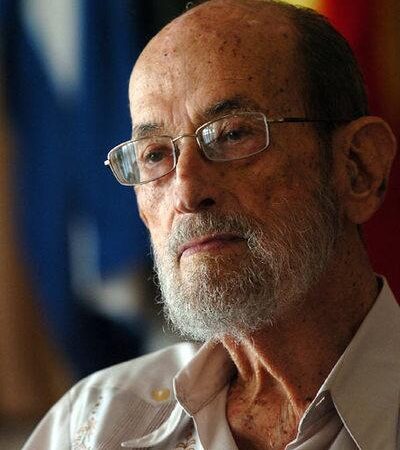
Cintio Vitier and the Questions That Illuminate
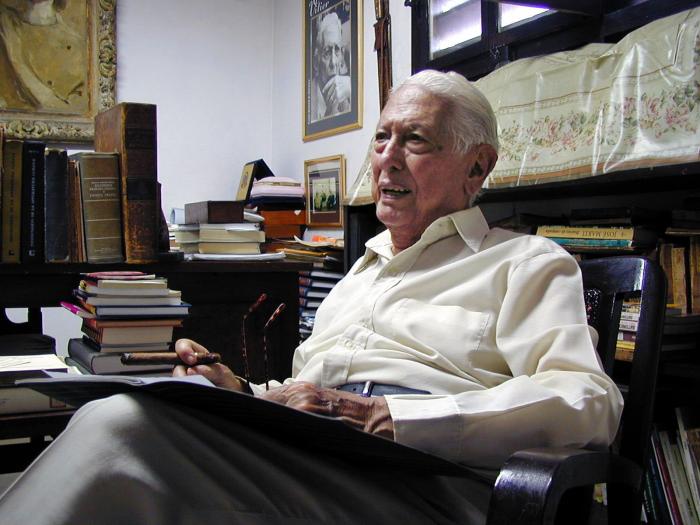
In Cuba’s cultural history, few figures have been able to move with equal depth among poetry, essay writing, criticism, and publishing. Cintio Vitier belongs to that lineage of intellectuals for whom words are not merely a tool in the service of a particular discipline, but a realm of inquiry in which the destiny of a community is at stake. Spanning more than six decades, his body of work stands as one of the most sustained efforts to reflect on Cuban identity from its literary, spiritual, and ethical roots, without yielding to ideological simplifications or academic reductionism.
Born in Key West, Florida, on September 21, 1921, to Cuban parents, Cintio Vitier Bolaños spent his childhood and youth on the island, where he soon revealed an exceptional literary sensibility. His intellectual formation was shaped by the guidance of his father, poet Medardo Vitier, and by the Spanish philosopher José Ortega y Gasset, whose ideas on vital reason left a lasting mark on his thought.
But it was through his association with the generation gathered around the literary journal Orígenes, founded in 1944 by José Lezama Lima and José Rodríguez Feo, that Vitier found his true intellectual home. That publication, now regarded as a landmark of Hispanic American literature, articulated for more than a decade a vision of Cuban culture as a space of resistance to banality and as a celebration of what Lezama called “the imaginary eras.” From its very first issue, Vitier was one of the group’s most active contributors and most penetrating critics.
Essayist and university professor Enid Vian, in her studies of the Orígenes tradition, has noted: “Cintio Vitier played an essential role within Orígenes: that of systematizing, with rigor and patience, the scattered intuitions of that generation; while Lezama dazzled with his metaphors and Rodríguez Feo opened a dialogue with foreign literature, Vitier organized, ranked, and transformed into critical discourse what in others was visionary impulse.”
That role as an intellectual bridge-builder did not diminish his poetic scope; on the contrary, it enabled him to imbue his poetry with a historical awareness uncommon in the lyric poetry of his time. His collections of verse, including Vísperas (1937), Extrañeza de estar (1945), and Sustancia (1950), reveal an intimate voice marked by perplexity before the mystery of existence and by an ongoing dialogue with the Catholic tradition, which Vitier experienced not as dogma but as an inward experience.
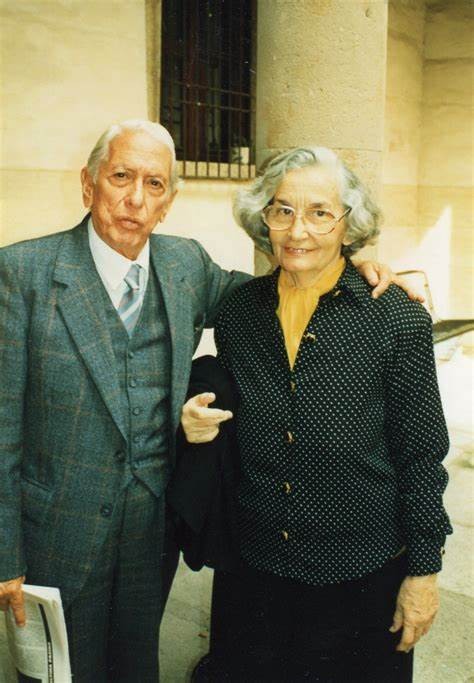
Vitier’s work as an essayist reached its fullest expression with the publication of Lo cubano en la poesía (1958), a monumental work that reconstructs the history of Cuban poetry from its colonial origins through the 1950s. The book, the product of several years of research carried out alongside his wife, fellow essayist and poet Fina García-Marruz, marked a turning point in Cuban literary criticism.
Poet and critic Jorge Luis Arcos, in the introduction to a reissue of the volume, writes: “Vitier did not write a conventional literary history; he developed a meditation on Cubanness, a search for the constants that give meaning to poetry written on the island, a reading that seeks to glimpse the nation’s secret soul through its verses.”
Cuban essayist Zaida Capote Cruz, in a study of the critical reception of Lo cubano en la poesía, has cautioned that Vitier’s work should not be read as a simple celebration of national identity, but as an exploration of its tensions and voids. Capote notes that he did not overlook the contradictions of Cuban history: “(…) what he did was attempt to read them from a perspective that does not renounce hope, that believes in the possibility of a profound reconciliation between what is Cuban and what is universal, between tradition and modernity, between faith and reason.” That conciliatory attitude, so far removed from binary thinking, has drawn criticism from both political dogmatism and postmodern skepticism, for which any search for meaning is viewed with suspicion.
Moreover, Vitier’s work cannot be fully understood without considering his relationship with Fina García Marruz, with whom he shared his life, his reading, and his intellectual endeavors for more than half a century. Together they edited anthologies, wrote essays, conducted archival research, and hosted literary gatherings.
His relationship with the Cuban Revolution was likewise complex and has been the subject of multiple interpretations. Vitier initially supported the revolutionary process, convinced that it opened unprecedented possibilities for cultural sovereignty and social justice. Over time, however, his relationship with the institutions grew strained, marked by misunderstandings and distance, although he never left the island or relinquished his participation in cultural debates. Essayist Enid Vian has stressed the need to move beyond Manichaean readings of this period: “Vitier was neither an organic intellectual nor a dissident; he was a man of faith, with all the contradictions that entails, who sought to maintain a critical dialogue with his time from a position that fit neither the official molds nor those of the opposition.” That uncomfortable freedom made him a figure respected by some and challenged by others, but impossible to ignore.
Transparency, musicality, and an ability to transform everyday experience into revelation have been among the qualities most celebrated in his poetry. Poet and translator Jesús David Curbelo, in an essay devoted to the final stage of his work, observes: “(…) in Vitier’s final poems there is a serenity that is not resignation but an achievement; a gaze that accepts death without dramatizing it, as simply another passage in the long conversation with mystery.” This spiritual maturity, uncommon in contemporary poetry, gives his work a wisdom-like dimension that transcends the boundaries of literary criticism and enters the realm of philosophical meditation.
Cintio Vitier’s legacy lies in his ability to remind us that culture is not a repository of dead works, but a living conversation among generations, a fabric of memories and aspirations that shapes us as a community. His defense of poetry as a form of knowledge, of criticism as an act of love, and of the nation as an ethical project continues to challenge those who approach his work without prejudice.
Translated by Luis E. Amador Dominguez
Photo: Granma