Onelio Jorge Cardoso: One Voice, One People, One Infinite Thread
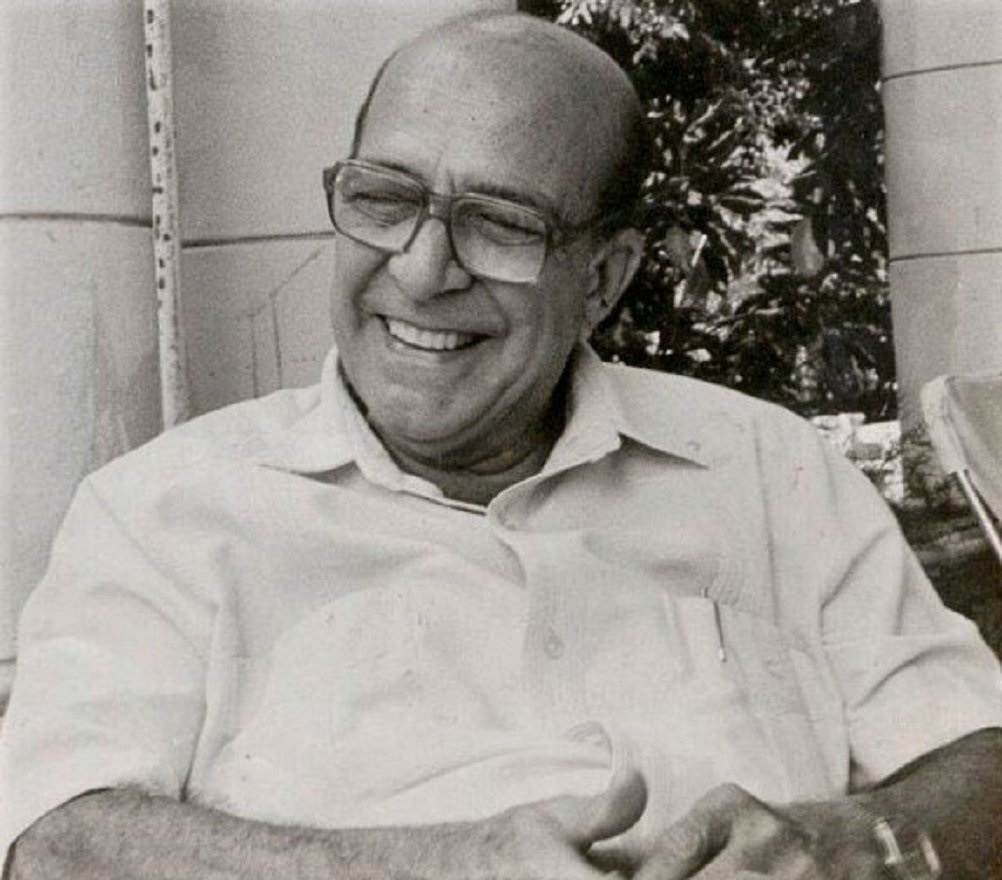
With his dark, restless eyes and a head full of rivers and mountains, the figure of Onelio Jorge Cardoso stands before us. When the calendar brings back the date of his birth — that May 11, 1914, in the small town of Calabazar de Sagua — Cuban literature is not simply observing an anniversary, but reaffirming the endurance of a gaze that transformed hardship and the rural landscape into high art.
The boy born in the old province of Las Villas was not cradled in privilege. The son of a mambí captain who fought alongside Gómez and Maceo, and of a mother of refined sensibility, he inherited both a raw emotional sensitivity and an earthy love for Cuba. Life denied him a university education for lack of money, but granted him, in exchange, a much broader academy: the road. Before fully assuming his authentic identity as a writer, Onelio worked as a traveling salesman, a medicine peddler and a rural schoolteacher alongside poet Raúl Ferrer in a small school at Central Narcisa. Those itinerant trades seasoned him in the human clay that would later take shape in his unforgettable characters, the very ones who seem to speak in hushed voices beneath the porches of small towns.
His literary debut was no accident. In 1945, at age 31, he won the prestigious Alfonso Hernández Catá Prize for his short story Los carboneros. It was a flash that illuminated an undeniable talent. Yet his definitive consecration would come not from academic circles but from the popular ear, because Onelio, before becoming a writer of the study, was an insatiable listener. He drew nourishment from the oral cadence of the guajiro, from legends whispered in the barracks, and from anecdotes that traveled on the running boards of trucks. He listened to the heartbeat of rural people, his sharpest critics always observed, and that syncopated pulse became the driving force of his prose.
It is impossible to speak of this author without mentioning the masterwork that functions as a mirror: El cuentero. In its pages, Juan Candela is not merely a character; he is a mask, an alter ego who reveals the essence of his creator. That man “with a fine beak for telling stories,” who lit up the night with a lantern while the charcoal burners rested their bodies bent by the weight of the sun, is the living image of Onelio himself. Critics rightly insist that the character possessed the author’s own gifts: a capacity for wonder and the generosity to offer stories as relief from exhaustion. This symbiosis between character and creator marks a milestone in Cuban costumbrista narrative, because there is no condescension in his prose; there is a rough, truthful poetry that does not need rhetorical ornament to bloom.
The century of his life, which we commemorate with reverence, was not confined to books. Onelio was a worker of words on every front. After the triumph of the Revolution, he did not retreat into an ivory tower. He joined the founding of Uneac, headed the Institute of Musical Rights, and put his pen at the service of journalism as chief of special reports at the newspaper Granma and as a staff writer for the weekly Pionero. Long before that, in the 1940s, he had already explored radio, writing scripts and producing newscasts for the station Mil Diez. That radio vocation, perhaps less widely known, reinforces the idea of his perpetual creative youth: for him, there were no borders between the script, the news story and the tale. Everything was material ready to be shaped by his precise command of language.
It is moving to know that his imagination never abandoned the geography of childhood. Even after becoming the “Cuentero Mayor,” a Doctor Honoris Causa of the University of Havana and a recipient of the National Peace Prize, Onelio returned to the landscapes of Calabazar with the same curiosity as the boy who visited his grandfather’s stables, the stable of Don Quintín Cardoso that became the seedbed of his fantastic horse stories. He remained unwaveringly faithful to his earliest affections, as in the moment when, overcoming his grandmother’s objections, he lent his skates to Pedro Valdés, the poor boy from the village. That act of quiet justice defines the root of his literature: an ethic of solidarity expressed without fanfare.
Nearly four decades after his death on May 29, 1986, the presence of Onelio Jorge Cardoso still beats with enduring vitality. His legacy is not a museum piece; it is a living organism that breathes in the 1,200 emerging writers trained by the literary center that bears his name and in every reader who encounters Taita, diga usted cómo and feels compelled to look at the Cuban countryside with different eyes. Cardoso taught us that the homeland is not a heroic abstraction, but the sum of its small creatures, its hidden waterfalls and its anonymous charcoal burners. In his work, the insignificant becomes epic. And perhaps that is the storyteller’s greatest miracle: convincing us that magic — the kind we search for in distant books — was always there, in the voice of that man who traveled the old roads with a head full of rivers and mountains.
Translated by Luis E. Amador Dominguez
Photo: Prensa Latina