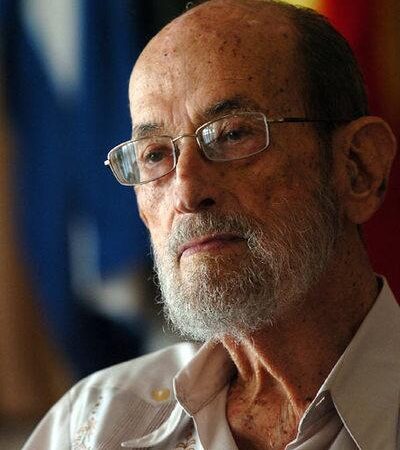
Héctor Zumbado: The Art of Thinking with a Smile
In Cuban literature, few figures stand out with the paradoxical clarity of intelligent humor—one that does not end in easy laughter but leaves behind a trace of reflection, a faint unease beneath the smile. The National Humor Prize is not an award for a single anecdote, but recognition of a body of work that decoded the Cuban psyche through its everyday contradictions. To speak of this award granted to Héctor Zumbado (Havana, 1932) is to speak of a kind of poetic justice for an author whose raw material was always the absurdity of reality itself.
The jury, then chaired by writer and critic Enrique del Risco, highlighted his singular ability to portray Cuban social psychology without relying on direct jokes, instead creating humor through the defamiliarization of the everyday. This defining trait in Zumbado’s work was shaped in the pages of the youth weekly Pionero and, above all, in Bohemia, where his column Los beduinos became a generational landmark. There, Zumbado built a bestiary of national life in which a fan, a toothpaste tube, or a simple tricycle became eccentric narrators of scarcity and ingenuity. As his colleague and friend, journalist Rolando Pérez Betancourt, once noted: “Zumbado does not write humor about objects; he lets them speak, complain, philosophize, and in doing so reveal the absurdity of our material existence.”
Zumbado’s work goes beyond everyday realism because his tool is not ridicule, but logic pushed to the point of absurdity. Titles such as “¡Esto le zumba!”, “Prosas en ajiaco”, and “Amor a primer añejo” reveal a poetics of semantic displacement. He takes fixed expressions, proverbs, or slogans and subjects them to literal interpretation, stripping them of meaning and exposing their inherent nonsense. Scholar of humorous literature Osvaldo Gallardo describes this technique as a surgical dismantling of clichés. According to Gallardo, while other humorists amplify defects, Zumbado works through reductio ad absurdum: he introduces a logical question into an illogical setting and allows the reader to witness, amused and sometimes unsettled, the collapse of official discourse. His well-known rhetorical question, “¿Y por qué no?”, which became a generational catchphrase, is in fact an aesthetic program: an invitation to subvert order through imagination.
Among his contemporaries, Zumbado emerges as an obsessive stylist. It is said he could spend hours refining a paragraph so that the comic effect depended not on a striking word but on precise cadence. “He detested noisy improvisation; he sculpted the exact silence before the punchline,” recalls writer and journalist Bladimir Zamora in a profile. This formal precision, bordering on literary craft, sets him apart from traditions of stage humor or immediate Cuban choteo. His natural space is the written page, where readers can reread, savor irony, and uncover the quiet melancholy often embedded in his most humorous texts.
Like all great humorists, Zumbado understood comedy as a form of resistance in the face of adversity. In his sketches of married life, power outages, or bureaucratic hardship, there is no cynicism—rather a shared understanding with the reader: reality is stubborn, but a well-placed exaggeration can preserve sanity.
Zumbado’s relevance remains remarkable. Re-reading his columns reveals that absurdity changes shape but not essence. Researcher Juan Carlos Reloba argues that he created a model reader: a Cuban who does not take himself too seriously and, precisely for that reason, is able to endure any circumstance in spiritual terms. That may be his greatest legacy: having taught a country that when logic collapses, the sublime consolation of intelligent laughter still remains.
Translated by Luis E. Amador Dominguez
Photo: Granma