Juan Formell: The Architect Who Made Thought Dance
When Juan Formell was born in Havana on August 2, 1942, Cuban music possessed a prodigious wealth of traditions, yet they existed in separate worlds: son held its rural throne, feeling lingered in the shadows of the bolero, and jazz remained viewed with suspicion by a select few. Sixty-eight years later, when he died in 2014, Formell left behind a body of work that had established a new tradition—one without which Cuba’s sonic landscape cannot be imagined without the imprint of Los Van Van. Musicologist Laura Vilar captures it with a precise image: “Formell achieved what seemed impossible: he made a popular dance orchestra think like an avant-garde ensemble without ever losing the pulse of the streets.”
Formell was not a child prodigy but rather a young man who grew up surrounded by records by Arsenio Rodríguez and Cachao’s jam sessions, with one ear tuned to the radio and the other to the conversations of musicians who frequented his father’s home, including his father, the musician Francisco Formell. Before turning twenty, he was already working as a bassist in the orchestra led by Pedro Jústiz (Peruchín), and soon afterward joined the legendary band of Carlos Faxas. Those years of intense apprenticeship, between cabarets and Radio Progreso studios, shaped a question that would follow him for decades: why should Cuban dance music limit itself to repeating formulas when the country itself was changing so rapidly?
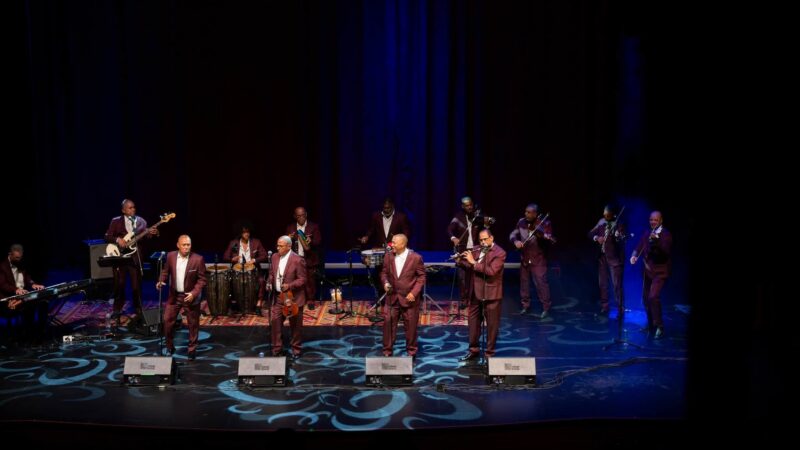
The answer came on December 4, 1969, when he founded Los Van Van with a repertoire that bewildered critics and dancers alike. That first lineup featured violins, cello, flute, and a rhythm section that fused the foundation of son with patterns from contemporary music. Formell introduced the electric guitar, the electric bass with an unprecedented melodic role, trombones influenced by rock, and, above all, the concept that would become his signature: a rhythmic structure built on overlapping irregular accents, inspired by the patterns of changüí from Guantánamo that he had heard as a child. Researcher José Reyes Fortún argues that songo is not a genre but rather a way of thinking musically—a method that allowed Formell to incorporate any influence without ever losing a profoundly Cuban sound.
That ability to integrate explains the central paradox of his legacy: Los Van Van became Cuba’s most popular band precisely because it was also its most experimental. While other groups repeated proven formulas, Formell wrote pieces such as “Chirrín chirrán” (1974) and “El baile del buey cansao” (1978), works that demanded from dancers a new perception of rhythm and movement. Choreographer and critic Rosario Cárdenas has noted that he “educated the ears and feet of three generations of Cubans. He forced them to dance off-beats, to anticipate accents where none were expected, to listen to silence. In his own field, he was a radical and joyful educator.”
The phenomenon extends far beyond music itself. Formell’s lyrics created a social chronicle of Cuba over four decades without resorting to propaganda or moralizing. From the everyday irony of “La Habana no aguanta más” to the despair disguised as rumba in “Somos cubanos,” from the playful eroticism of “Que no, que no” to the generational tenderness of “Por encima del nivel,” Formell portrayed the dreams, hardships, and daily resilience of his contemporaries through a language that blended colloquial speech with streetwise lyricism.
Poet and essayist Víctor Fowler, in a study on the relationship between popular music and literature in Cuba, states that “Formell belongs to a rare lineage of chroniclers who transformed the danceable refrain into a vehicle for exploring national identity. His songs are part of the canon of contemporary Cuban oral tradition.”
Not everyone understood the scope of his vision in the early years. Certain musical traditionalists accused Los Van Van of “diluting” tradition with foreign elements, a criticism Formell dismissed with the same ironic elegance that characterized his songwriting. He continued incorporating synthesizers in the 1980s, flirting with hip-hop in the 1990s, and engaging with reggaeton in the first decade of the 21st century, convinced that Cuban identity was not a museum piece to be protected but a living organism that breathes with the changes of its time. Musicologist and National Music Award winner Alicia Valdés defines him this way: “Formell did not modernize Cuban music; he understood that Cuban music itself was a modernizing force. That intuition sets him apart from any imitator.”
Although it is tempting to view Formell’s career as a straightforward triumphal arc, that would be an unfair simplification. His life was marked by the hardships of the Special Period, the diaspora of essential musicians—such as Pedro Calvo, whose temporary departure in the 1990s wounded the group’s sound—the aesthetic debates with younger generations, and, above all, the daily challenge of sustaining a fourteen-member musical machine in a country where material hardship was always present.
Even so, Juan Formell never stopped composing, rehearsing, or refining arrangements until the early hours of the morning. Art historian Graciela Pogolotti has emphasized this ethical dimension of his work: “In a context where so many things were falling apart, Formell embodied the determination to pursue excellence. His discipline was not rigidity, but rather a form of faith in the value of craftsmanship.”
Thirteen years after his death and as another anniversary of his birth is celebrated, Los Van Van’s music continues to resonate on every corner of the island and in every Cuban community abroad. Yet perhaps the most remarkable aspect is the survival of his method. Songo did not remain a museum artifact; it permeated the ways of creating timba, the explorations of young musicians such as Alain Pérez, the Afro-Cuban jazz movement, and even certain areas of Latin pop that remain unaware of their debt to it. The question Formell posed in the 1960s—how to sound Cuban without repeating oneself, how to remain contemporary without losing one’s roots—remains the central question of Cuban music today. And the answers, fortunately for everyone, are still far from definitive.
Juan Formell’s work did not close a chapter; it kept open the possibility of imagining Cuban identity as a territory without sealed borders, a place where tradition does not look toward the ground but toward the horizon.
Translated by Luis E. Amador Dominguez