Life, Brushstrokes, and Torment: The Art of Carlos Enríquez
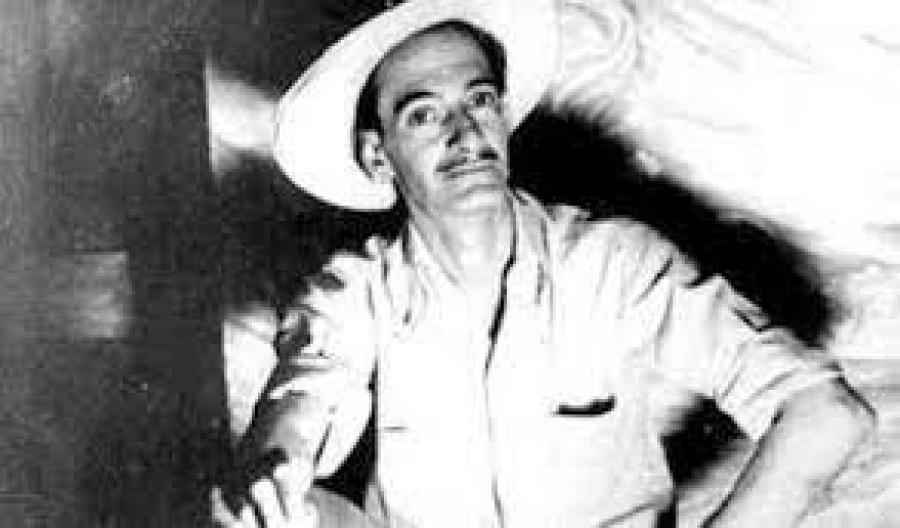
Carlos Enríquez was born on August 3, 1900, in Zulueta, a town in the former province of Las Villas, where sugar mills set the rhythm of daily life and social divisions could be read in the color of one’s skin and the grandeur of one’s front porch. Born into a prosperous family and raised amid the scent of the sugar mill and the voices of cane cutters, he would, three decades later, become the defining painter of the Cuban avant-garde, forging a pictorial language that stripped the island bare to reveal its innermost dreams.
The distinguished art historian Adelaida de Juan, one of the foremost authorities on Cuban art, summed up his achievement this way: «Enríquez did not paint what was Cuban; he painted Cuban identity as conflict, as rupture, and as ecstasy.»
His artistic training unfolded through the constant movement between Cuba and abroad that characterized the first generation of the Cuban avant-garde. In 1920, he traveled to Philadelphia to study business—a course of study imposed by his father—but instead enrolled at the Pennsylvania Academy of the Fine Arts. There he encountered Impressionism and American Social Realism. More importantly, he came to understand that art was not merely decoration but a way of knowing the world.
When he returned to Cuba in 1924, he possessed solid technical training but was deeply dissatisfied. He sensed that the true Cuban landscape could not be contained within the academic conventions he had mastered. In a letter preserved in the archives of the National Museum of Fine Arts, he expressed what would become his artistic manifesto: «I’m tired of pretty palm trees. Cuba must be painted from within—from where it hurts and where it burns.»
That determination to «paint from within» led him, after a brief return to the United States and formative stays in France and Spain, to develop the style he called romancero guajiro, a term that requires some explanation because it can easily be mistaken for mere folklore. It was not a picturesque vision of the Cuban countryside. Reaching full maturity between 1934 and 1945, the romancero guajiro became an exploration of the deepest layers of the Cuban collective psyche. Desire, death, violence, sensuality, and mestizaje emerge on his canvases as elemental forces that dissolve the boundaries between figures. Painter and critic Antonio Alejo observed that Enríquez understood before anyone else that the Cuban landscape was not a backdrop but a state of being. «That is why his human figures merge with the wind, the palm tree, the horse, and the bed. There is no boundary between the individual and the surrounding world.»
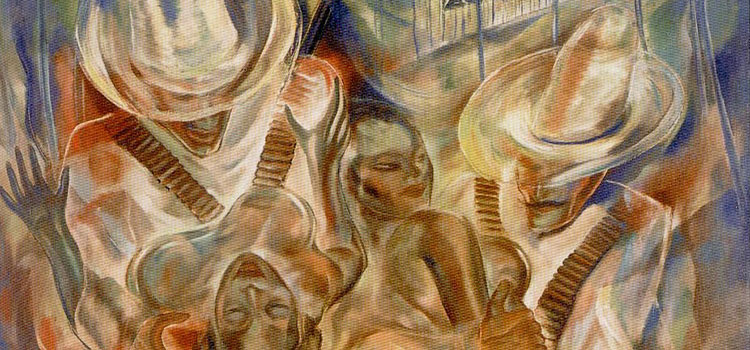
That radical fusion of body and landscape reaches its fullest expression in El rapto de las mulatas (1938), a monumental oil painting in which female sensuality and masculine ferocity intertwine in a whirlwind of translucent forms, simultaneously revealing the lovers’ anatomy, the horse’s powerful hindquarters, and the surrounding vegetation. The painting caused a scandal when it first appeared. Conservative critics condemned it as obscene and excessively «French»—an irony the artist answered with a remark quoted by researcher Luz Merino Acosta in her landmark monograph: «What is Cuban is not the picturesque but the profound. And at this island’s deepest core lie sex, blood, and mixture.»
Enríquez’s technique is inseparable from his vision of the world. The translucent figures that define his mature work—bodies that seem to pass through one another as though the skin were a membrane permeable to light—are not displays of formal virtuosity but an expressive necessity. He painted a reality in which nothing is entirely solid, where bodies possess and penetrate one another, where the landscape breathes within its inhabitants, and where people dissolve into the atmosphere around them. Essayist and art critic Rufo Caballero linked this visual strategy to an epistemology of mestizaje: «Enríquez’s transparencies do not derive from European Symbolism but from a distinctly Cuban understanding of identity as something fluid, where Spanish and African ancestries remain visible through one another without ever canceling each other out.»
His life was every bit as intense and unrestrained as his art. In 1926, while in Paris, he met painter Alice Neel, whom he married and with whom he had two daughters. Their relationship—stormy yet decisive in shaping both artists—ended in separation, though never in oblivion. In 1934, Enríquez returned permanently to Cuba and settled at El Hurón Azul, his home and studio on the outskirts of Havana. It soon became the epicenter of a freewheeling bohemian circle where artists, writers, musicians, and colorful characters from every walk of life gathered. Novelist and journalist Enrique Cirules, who researched this period for an unfinished book, wrote: «El Hurón Azul was the laboratory where Enríquez distilled his Cuban identity. There were no schedules, no bourgeois morality, and no boundary between life and painting. Everything became raw material: the rum, the ceiba tree in the courtyard, the bodies of lovers, and the ghosts of the sugar mills he had known as a child.»
That fusion of life and art also carried a tragic dimension that critics have not always interpreted without moralizing. In an essay examining the relationship between artistic creation and self-destruction in the Cuban avant-garde, scholar Caridad Blanco de la Cruz cautioned: «…reducing Enríquez to the stereotype of the ‘cursed artist’ obscures the iron discipline beneath the apparent chaos of his canvases. One need only examine the surviving preparatory drawings to see that every transparency and every overlapping plane reflects meticulous calculation.»
His body of work also includes a lesser-known literary legacy. Enríquez wrote two novels—Tilín García (1939) and La feria de Guaicanama (1941)—in which he brought to prose the same exploration of Cuba’s deepest realities that characterized his paintings. The first tells the story of a mixed-race boxer and reflects on machismo and violence in Cuban society; the second recreates life in a rural town during the early decades of the twentieth century in language that blends lyricism with brutality. Poet and essayist Roberto Méndez Martínez has underscored the significance of these works: «Enríquez’s novels are not merely an intriguing complement to his paintings but an indispensable part of understanding his entire artistic vision. They reveal the same determination to name the unnamable, to confront desire and death without the veils of hypocrisy.»
Carlos Enríquez died in Havana on May 2, 1957, at the age of fifty-six, amid the political and social turmoil that foreshadowed the collapse of the Batista dictatorship. His premature death, attributed to liver cirrhosis, cemented the legend of an artist who lived as he painted—at the limits of endurance and beyond the constraints of convention. Yet that legend has often obscured the true scope of his achievement. He was not merely an isolated, self-destructive genius but the artist who forged a pictorial answer to the central question that haunted the Cuban avant-garde: how to represent national identity without lapsing into picturesque localism or imitating European artistic traditions. His answer—his transparencies, his romancero guajiro, and the dissolution of bodies into the landscape—remains one of the most original and enduring achievements in the history of Cuban art.
As we commemorate the anniversary of his birth, it is worth asking what continues to resonate in his work for today’s artists and audiences. Perhaps Enríquez’s enduring relevance lies not in the repetition of his visual language but in the radical nature of his artistic conviction: that painting is an act of knowledge, a way of penetrating reality to its deepest layers and revealing what ordinary vision prefers to ignore. To stand before El rapto de las mulatas, Campesinos felices, or any of his landscape-infused female nudes is to witness something that transcends aesthetics. It is to witness the moment when an entire island confronts itself and finally recognizes its own turbulent, contradictory beauty.
Translated by Luis E. Amador Dominguez