Wifredo Lam’s Perpetual Jungle, the Mestizo Soul of Cuba
Few artists manage to embody, in the very fabric of their work, the contradictory yet fertile pulse of a nation. Wifredo Lam belongs to that rare breed of artists whose biography is, in itself, a map of mestizaje, a document that illuminates the tensions and triumphs of Cuban identity.
Born in Sagua la Grande on December 8, 1902, the son of a Cantonese Chinese scribe and a mulatto woman descended from African slaves, Lam grew up in a world where the millennia-old wisdom of the East engaged, not always peacefully, with the elemental fury of the orishas. His godmother, a santera deeply rooted in popular traditions, opened the doors early to a world governed by the drum, trance, and spiritual resilience. For Lam, that heritage was no folkloric ornament, but the foundation of a way of seeing that, decades later, would shake the halls of modern European art.
The young painter’s academic training in Havana at the San Alejandro Academy gave him the technical tools he needed, but it did little to tame his curiosity. His journey to Spain in 1923 marked the beginning of a long exile that would take him to Madrid, then Barcelona, and finally Paris, where fate brought him face to face with Pablo Picasso. Their encounter in 1938 was a flash of lightning that divided his career in two. Fascinated by the “primitive” power he perceived in the Cuban artist, Picasso introduced him to the circle of Surrealists. André Breton, the movement’s leading figure, saw in his canvases an unprecedented bridge between the European unconscious and Caribbean magic. But Lam refused to be confined by labels. With the clear-eyed understanding of someone who had lived between two worlds, he knew that Surrealism was a passport, not a destination.
The true turning point in his pictorial language came when, fleeing the Nazi occupation of France, he returned to Cuba in 1941. That homecoming, charged with an almost messianic sense of expectation, brought him face to face with the stark reality of his island: structural poverty, racial discrimination, and the clandestine survival of Afro-Cuban religions in the face of a modernity that denied them. Lam did not paint that reality as a compassionate observer, but as an initiate who recognized in the wilderness, the sugarcane, and the mestizo body an ancient form of knowledge. Cuban researcher Luz Merino Acosta, in her studies of the island’s visual arts, emphasizes: “Lam did not copy the jungle; he embodied it. In his work, sugarcane is not decorative landscape; it is a living presence, a witness demanding justice.”
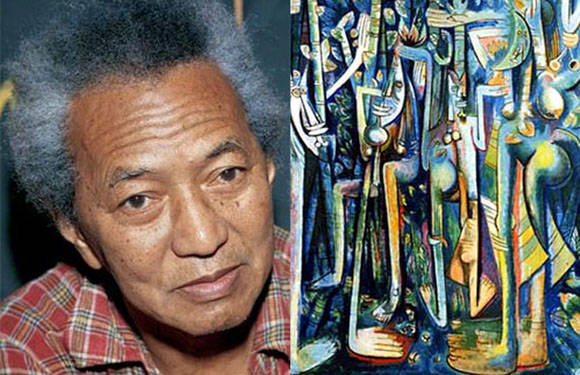
That profound understanding came to fruition in his masterpiece, The Jungle (1943). Far from being a gentle or reassuring work, it is a visual warning. Hybrid creatures, half human and half plant, emerge from a dense backdrop of leaves and stalks, their gazes confronting the viewer and their hands seemingly invoking a secret ritual. Cuban painter Manuel Mendive, a self-professed heir to that tradition, has said on more than one occasion: “Lam opened a door through which all Caribbean artists have entered since. He taught us that the sacred African world could be painted in the language of modern art without asking anyone’s permission.” Mendive points to an essential lesson: decolonizing the gaze does not mean ignoring the avant-garde, but turning it into a tool of one’s own.
Lam’s work after The Jungle did not become trapped in the formula that had made him famous. He continued to explore the figure of woman as an earth goddess, syncretism as a strategy for survival, and the body as a territory of resistance. His palette sometimes grew darker; his lines became more distilled. Artists of later generations, such as Cuban painter Roberto Fabelo, recognize in this mature period a lesson in aesthetic ethics: “Lam did not repeat himself to please the market. He kept painting what pained him, what challenged him, even when the art world wanted to freeze him in a single image.”
Lam died on September 11, 1982, but he retained that attitude throughout his life, an attitude rare in contemporary art, making his legacy a beacon whose light continues to shine into the future.
He was not a picturesque ambassador for Cuba, but a visual thinker who deciphered, before many sociologists did, the syncretic nature of the island’s culture. Today, his work functions as an archive of resistance: each canvas is a spell against oblivion, an assertion that identity is not a fixed essence but a living construction, forged through encounters, violence, and alliances. That is why, when we revisit his work, we do not simply enter a museum; we enter a forest where every shadow has a name and every form is a drum. All of Cuba, with its contradictions and fierce beauty, is painted in that perpetual jungle Wifredo Lam dreamed for us.
Translated by Luis E. Amador Dominguez
Photo: Prensa Latina